
 How Sleep Affects Dopamine
Before we begin: Brenna Huckaby is a Saatva partner. The experiences she shares are her own personal stories—not medical or professional advice.
Welcome to Superpower, the podcast about how sleep, recovery, and mental resilience drive peak performance. In this episode, Brenna Huckaby, U.S. Paralympic gold medalist, shares how losing her hair made her reevaluate her identity, movies that inspire her, and how being a mom actually helped her be more competitive.
You can listen to this episode on Spotify or Apple Podcasts or watch the episode below.
Superpower podcast episode with Brenna Huckaby: transcript
Introduction
Dave Briggs: Can choking on the biggest stage actually be the best thing that ever happened? Welcome to The Superpower Bedcast. I’m Dave Briggs—and choking was ultimately a springboard for Paralympic gold medalist snowboarder, Brenna Huckaby. Then again, she’s the kind of person, she tells us, that credits losing a leg to cancer for becoming a world champion. She’ll tell us how Happy Gilmore, Miley Cyrus, and Amy Poehler inspire her—and what it meant to grace the cover of the Sports Illustrated Swimsuit Issue alongside Tyra Banks and Martha Stewart. I hope you enjoy this conversation with the incredible Brenna Huckaby as much as I did.
Meeting Brenna
DB: Cancer survivor. Amputee. Five-time world champion. Three-time gold medal winning snowboarder. Mom of two. Spokesperson. Do I have it all?
Brenna Huckaby: I think so.
DB: How do you sum yourself up? One word—give me one word that sums up Brenna Huckaby. It’s difficult. Overachiever?
BH: Literally, Mom—that’s all I can think.
DB: Mom?
BH: Yeah.
DB: I thought you’d say fearless.
BH Oh, I am so afraid.
DB: Because I’ve heard you use that word often.
BH: Mm. That’s so funny.
DB: Not true?
BH: You know, I think I’ve grown. I could see in my past where fearless absolutely was a word I would use.
DB: You have, on camera.
BH: Yeah, I believe you. I believe you.
DB: On social media. On the snow. You are fearless. But you’re afraid right now.
BH: I’m not. Not right now, but maybe, because I’m like, oh my gosh, I’m such a liar. No, I would say there was a time in my life where I wore being fearless as a badge of honor because I saw I was above the fear, but really I was shoving it deep down and “overcoming” it. But now, as a healthier, more mature woman, I absolutely feel fear, but I’m brave and I move through it, right? So I’m brave.
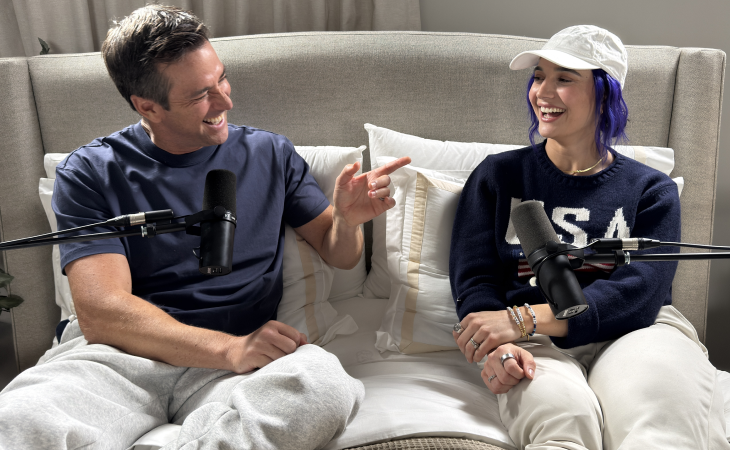
DB: I would be fearful being in a bed doing a podcastwith another dude. It is an interesting situation, right?
BH: I guess if you word it like that.
DB: You hadn’t thought about it that way?
BH: No.
On “Inspiration”
DB: One word that you have not always been comfortable with, which is interesting to me, is “inspiration.” And you are probably the most inspirational figure I’ve ever met in my life, yet you’re not entirely comfortable with that?
BH: Yeah, well, there’s a caveat. So, I can understand being an inspiration when talking about my achievements and just what I’ve navigated in my life, absolutely. However, I get told I’m an inspiration constantly by people that have never seen me do anything cool. So simply going to the store and buying milk—I’ve been called an inspiration. And that is where I’m like, keep it.
DB: For the getting milk?
BH: Mhm.
DB: I’m sure they’re complimenting all of it. Not the milk part.
BH: But they don’t know all of it, right? So, it’s a stranger.
DB: Ah, you think you don’t stand out, huh?
BH: Well, I mean, I have purple hair, so.
The purple hair
DB: I was going to ask you about the purple hair. It is a signature of yours. What’s the backstory?
BH: Yeah, so, before I had cancer, I had, well, this dark hair, I don’t know if you can see it, is very similar to my natural, but I used to be in the sun all the time so I had these amber, or auburn, highlights that were just natural and beautiful. And everyone would tell me, “People would pay so much money to have hair like that. Never dye it. Never dye it.” Well, then I get cancer and I lose it. And I had to go through this whole identity—and it sounds superficial, like, your hair. But when you are told you have amazing hair and then you lose it, you have to go through a process of relearning what makes you beautiful and special and all the things. And so, after cancer, I became a young mom, and I was trying to figure out my new identity, and I was like, “I want to dye my hair purple.” And so for me, it was like, life is fleeting, identities are fleeting, I can dye my hair, and that doesn’t change who I am as a person. But it actually does, it gives me a lot more confidence to be who I am and show up how I want and not care if I had to bleach my beautiful hair to get there.
DB: You rock it. It is awesome.
BH: Thank you.
DB: I don’t know what I’d do, all I have is hair. I don’t have your talent. So if I lost my hair, that’d be it, man.
BH: Whatever. Nah, you’d figure it out.
Sleep and recovery
DB: We’re going to circle back to all of that. But I do want to talk about, to get through all that, you must be a professional sleeper. You must really understand the importance of restorative sleep. Do you have a sleep routine? How important is it?
BH: Yes. Okay, so, I have a secret. I actually worked with a sleep psychologist to help me with my sleep.
DB: So you had issues prior to that?
BH: Well, I didn’t really have issues, I’m just slightly neurotic and wanted to have the best sleep ever. So I was like, help me find my blind spots around sleep. And so I hired someone to help me.
DB: This is a first for me.
BH: Yeah, I didn’t even know it was a thing. So typically, with insomnia, you might get—
DB: I mean, I need therapy, but I didn’t know there was—
BH: Yep. Sleep—they study how to mentally prepare yourself. And then of course all the physical things too that you can do.
DB: What did you learn from this person?
BH: So, routine, very important. We’re going to get into it. Colder room. Dark room. We all know these things.
DB: Right. Blackout shades?
BH: Yep. Your bed should only be used for sleep. Well, you know.
DB: As opposed to?
BH: As opposed to getting on your phone, reading, watching TV, all the things I enjoyed doing prior—well, I still do, I’m not going to lie—but, I’m more cognizant of it. Because I’m like, okay, if I’m in a period of time at a competition or I just have a lot going on and sleep needs to be a priority, I only get in my bed when it’s time to sleep. And it really changes something in your brain.
DB: That your brain just says, “Alright, it’s time to shut it down.”
BH: Yes.
DB: That’s really interesting. I’m a disaster of a sleeper, and maybe that’s why. This will make you—you won’t believe this: Jessica Long, who we interviewed, another amputee, iconic Paralympian, she’s been known to bring a charcuterie board to bed to watch TV.
BH: Wait.
DB: No joke. Full-on charcuterie board. Olives, cheese, all sorts of—. Can you believe that?
BH: I want to hang out with her. I want to go have a sleepover. So, I don’t do that. That’s amazing, but no, I try, when I need sleep, that is 100 percent, I’ve noticed such an increase in my quality of sleep when I do that. I like darkness. I have an eye mask that I prefer, a silk pillowcase, all the things that make it cozy. Skincare before I go to bed.
DB: Okay, so there’s quite a routine.
BH: It is, yeah.
DB: Are we talking eight hours, nine hours, what?
BH: Of sleep?
DB: Yeah.
BH: Yeah, I shine with nine hours of sleep, but I rarely get a full nine hours.
Travel sleep hacks
DB: And you travel so much, and around the planet. How do you maintain a consistent environment? That’s one of the tricks.
BH: Yeah, so, I always have my eye mask with me. You know, I need to start traveling with my pillowcase. Talking about this now, I’m like, why did I not bring that? Great question. Skincare, I keep with me. The first thing I do when I get into a hotel room is drop the temp so that I know it’ll be nice and cold by the time I go to bed.
DB: Do you know the degrees?
BH: I go to 67, 68.
DB: Oh, that’s cold.
BH: I like it cold, yeah.
The cat named Mouse
DB: Okay, I like that. That’s interesting. I’m curious because—this is a personal story—you have a cat named Mouse, which is an unusual-looking cat and an interesting name as well. Does the cat named Mouse ever get into bed with you?
BH: No—okay, yes. She doesn’t sleep with us because she’s so rude. I close my door because she will—this is what she’ll do. She will run downstairs—she sleeps with the girls a lot, so she goes upstairs, sleeps with my kids—but 3, 4 am, she likes to run full-speed down the stairs, into our bed, do a parkour on my husband’s and I’s face, and then runs back upstairs. So we keep our door closed to avoid shenanigans.
DB: I am sleep-deprived because my cat is needy only in the middle of the night. And it’s not my wife, he sits on my face, and snuggles right here, and I give it to him. I give him the tummy rub, and three times—cats are so rude.
BH: Dude, they are, I love it.
DB: They’re so selfish. I hear you’re a cat person.
BH: Okay, I didn’t grow up—I grew up with dogs. I was deathly afraid of cats.
DB: You switched to cats?
BH: They are the best. So what happened is, they’re misunderstood.
DB: No.
BH: Yes.
DB: They’re selfish and evil.
BH: No. They’re roommates. They’re not your loyal companion. They are their own thing, and they’re your little roommate, and you can’t—
DB: Your roommate that don’t give a damn.
BH: Yes, and I love it.
DB: You do?
BH: I do, and it’s so mean, because she loves my husband more than me. But I love her more than anything. And I will die for her.
DB: This is such a cat person thing.
BH: I know, I’m insane.
DB: Dogs are so loyal, they would never wake you up in the middle of the night unless they absolutely had to.
BH: I do love dogs too, but I also just love cats.
DB: And cats don’t give you any love.
BH: She does.
DB: No, they don’t. How?
BH: She sometimes purrs.
DB: Sometimes purrs.
BH: And it’s such a gift when she does, you’re like, I did—okay, well, honestly my cat loves me a lot.
DB: It’s not giving you love, it’s enjoying the selfishness.
BH: No, it’s great, but I have to earn it because I travel and she gets mad at me.
Louisiana to snowboarding
DB: Fair. So cat named Mouse is unusual. Snowboarder from Louisiana goes hand in hand. There aren’t many snowboarders from Louisiana. So how did we get there?
BH: Yeah. Great question. We’ll go back to cancer. Everything just seems to start from cancer.
DB: Everything goes back to cancer.
BH: Yeah.
DB: And you say that with a smile, which is really awesome, by the way.
BH: Oh, thank you.
DB: And you own it.
BH: At this point it just feels so matter-of-fact, you know.
DB: It’s awesome. Okay, go on.
BH: Yeah. I’m sure if I were talking about the specifics, might not be smiling.
DB: Right.
BH: However, it’s given me so much. Going back to cancer—before I had cancer, I was a competitive gymnast.
DB: And you were 14 when you were diagnosed?
BH: Correct. Yes. So up until 14, competitive gymnast, going to college, hopefully on a scholarship to do gymnastics, that was my trajectory. Got cancer, amputation, gymnastics is over. And my hospital that amputated my leg saved my life, they would take kids who lost mobility from cancer on a rehabilitation ski trip. And I remember when I heard about this trip, I was like, sounds like my doctors just want to go skiing, and they just made this whole thing up, but—
DB: Quite a scam.
BH: Right? I was like, genius. I see why you’re a doctor. But no, so their whole idea was, if they could take kids who had lost mobility from cancer to the mountains to ski down literal mountains, then when they got home, they could conquer their figurative mountains of everyday life.
DB: Makes sense.
BH: Yeah, like I can go to the mountains, do something really challenging, so when I get home, the things that feel so challenging, I can do it.
DB: So you got on a snowboard right then and there?
BH: So that’s where I learned. I went on that rehabilitation ski trip, learned to snowboard, the doctors were right—it gave me a new sense of confidence, and just perspective of the different sports I could do. And a year later after that trip, my mom and I moved to Utah so that I could continue snowboarding, heal from cancer, and, well, we didn’t expect it to turn into all of this, but here we are.
DB: And do you remember that moment when you first got on that snowboard and what that feeling was like?
BH: Yeah.
DB: Empowerment?
BH: Absolutely. Freedom. I just remember being like, I’m in snowpants, nobody can see my prosthetic leg. I just felt so myself without being identified by my disability. Now, I have a totally different perspective on it, but then, that was so important to me.
The couch and the turnaround
DB: Prior to that, it wasn’t always a smile. It wasn’t that easy. I know there were some times that you were on the couch, and it was difficult. How difficult was it, and what got you up off the couch?
BH: Extremely hard. I mean, I lost everything that I knew about life at that point. But, I had an intervention with my older brothers, and I’m very competitive, obviously—and they were like, “Brenna, everyday that you are lying on this couch unable and unwilling,” it was a lot more unwilling than unable, “to pick yourself back up, to figure out where you want to go, cancer is still winning. We know that you beat it, but it’s still beating you in this new way.” And I was like, oh, hell no, I better figure this out.
DB: Reverse psychology. They knew, they played to your competitiveness.
BH: Mhm. And it still works. That still works today.
Her happy place
DB: That is awesome. I know sometimes you go to a happy place. What is that happy place?
BH: Yeah. I think it just depends on different times in my life. When I’m competing, and I’m resetting in between events, I’ll send myself home. So I’ll close my eyes and Happy Gilmore myself back into my family and my life.
DB: When he’s riding around—I remember the scene, they bring a pitcher of beer and then there’s the guy riding the midget on the—
BH: Yeah, yeah, yeah, yeah—so we Happy Gilmore ourself. And also, there was a time when I would go actually back to that same couch that I laid under in cancer, but I don’t know, it was a happy place. A happy memory before everything happened.
Cancer’s affect on her professional career
DB: Just a few days ago, I had the opportunity to interview Jim Abbott—I don’t know if you know Jim. He was a Major League Baseball pitcher who had one hand.
BH: Yeah, I know his name.
DB: Literally, one hand, played 10 years in the bigs, he no-hit The Indians with the New York Yankees. And I said to him, “Jim, would you have been in the Major Leagues if you had two hands?” And he said, “No one has ever asked me that in 30 years, and I’ve always known the answer. No.” He said, “I would not have been. That having one hand is what drove me.” Do you think you’d be a world-class athlete if you had—
BH: No.
DB: No? Wow.
BH: No. I don’t know if it’s more about the amputation or the cancer, but it changed my whole entire outlook on life. I think I would’ve gone to college and moved on. I don’t know if, yeah, I don’t think so.
DB: That’s wild, isn’t it?
BH: Yeah. Like weirdly glad I got cancer at this point talking about it, right? Because it’s—
DB: I mean, I don’t want to call it a blessing, of course it wasn’t.
BH: Well, a blessing in disguise, maybe.
DB: A blessing in disguise?
BH: Yeah.
DB: It obviously changed your perspective quite a bit.
BH: Absolutely.
DB: You seem beaming with happiness when I would be nothing but an anger ball.
BH: Well, it’s been 14 years, but yeah.
DB: Yeah. Have you always been—?
BH: You know, yes. I have. Even before I had cancer, it’s—
DB: You just naturally smile. It must hurt.
BH: Sometimes. Yeah, I just naturally have been like this. I don’t know. But that doesn’t mean I don’t have dark days or time periods of my life, you know?
Social media and mental health
DB: And when you do, you have this happy place to go back to from what I understand.
BH: Yeah. Try to.
DB: Maybe you need to close your eyes and tell me about the happy place. Where is it? What is it?
BH: Now I can’t stop thinking about Happy Gilmore.
DB: Happy Gilmore? It’s a great movie.
BH: So my happy place, yeah, when I’m competing, it’s often a way that I reset and just kind of gain some mental clarity for myself. But I’ll take myself back home—and whether that’s back home in Louisiana before all of this happened to me and I can hear my brothers and my parents are cooking, that’s one happy place, and also, I do the same thing but it’s my house now in Montana with my kids and my husband. And it’s all about feeling that sense of peace that both of those environments have given me at different times.
DB: You seem in your happy place on social media, when for a lot of people, it causes mental health damage. It seems to empower you. You did a pregnant dance on social media.
BH: Yeah, okay. I would definitely say there are seasons where I feel like I’m having so much fun online, sharing my life, doing my dances. But, oh my goodness, social media for me absolutely can cause some mental health problems. I’ve had to learn new ways of consuming content so that I don’t feel like I’m comparing myself to other people. And then also, there’s so much out of my control when it comes to posting that that can be a mental health thing for me, of like, I put all of this time into this message and it flops, it goes nowhere. Or the algorithm picks it up and sends it to the most wild group of people, and I’m like, ahhh, help. But I would say, what I love most about social media is the ability to take control of your own narrative and your own messaging and try to make your little slice of the internet a little bit better.
Motherhood
DB: Yeah, because there’s a lot of violent content out there. So as we’re approaching 2018 and PyeongChang, along comes one of life’s surprises in the form of Lilah in 2016. All of a sudden, you get pregnant, and for a lot, that kind of knocks them off of where their goals were. It didn’t you.
BH: It did at first.
DB: It did?
BH: Mhm. So, I was 19 when I got pregnant, which I was not meaning to. You know, I wanted to be more established in life. So when I found out I was pregnant, I can vividly remember sitting down on the same couch that I had cancer on, talking to my mom, and I was like, mom, I just feel like I’m going through cancer again in a way. I feel like I’ve gotten so far in this new life, in this new sport, and it’s being taken away—in a happy way, having a child I never thought I would have—but being taken away, nonetheless. And she was like, “Brenna, do you remember why you started snowboarding in the first place?” And I was like yeah, “I wanted to show kids that had cancer and lost their leg that their life can still be great.” And she was like, “Well, why can’t you do that for your daughter? Why can’t you take that same messaging and go do that for your daughter?”
DB: And you have.
BH: And I have.
DB: And how has being a mom changed you maybe as a competitor?
BH: Oh, I would not be on this couch talking to you right now if I did not have my daughters.
DB: Why is that?
BH: I didn’t take it as seriously. For me, it was a hobby. I mean, it wasn’t—that’s not the correct term—but I didn’t see myself doing anything more than that first Paralympic Games. I don’t know. I know it sounds crazy.
DB: I would’ve thought the opposite.
BH: No, I—
DB: It made you more serious as a competitor, being a mom?
BH: Yes.
PyeongChang 2018 Paralympic Winter Games
DB: That’s remarkable. So you’re a double gold medalist in the 2018 PyeongChang Paralympics. Take me to that moment where there was passing the finish line and looking up and knowing, or whether it was climbing atop, hearing the anthem.
BH: Ooh, there were so many moments at that Games. First of all, I went in, I had one woman who, still to this day, is my biggest competitor, and nervous, whether or not I was going to be able to beat her. Wow, same story today. She’s really good. But I knew, in 2018, I knew that if I could beat her, then I had a strong chance at a medal. The woman I was competing against had been to the Games before, they had that advantage on me. And so I mentally choked and I fell on all my training runs, which is not standard for me. It was not fun.
DB: And then, did the failure, if you will, fuel you?
BH: So, I choked, fell on all my runs, barely qualified. So what happened was because I was then at the very bottom of the group, my first competitor that I was racing was the person at the top of the group, which is my toughest rival. But I was racing to move onto first or second, and then if I did not win, then I would go to third or fourth. When I beat her, I knew. I was like, “Oh, we got this. I’m going for that gold.” And yeah, so that moment of, I’m choking, I’m falling, I’m going to race my number one competitor who I don’t know if I can beat her, and then I did beat her? And this massive feeling or relief was like, “Oh, I got this.” Indescribable. But what people often ask or wonder is, how the heck did I turn it around?
DB: And?
BH: Well, I thought about Lilah. I stood at the top of the course, I’m panicked, and I was just like, what am I doing this for? What am I doing this for? And I closed my eyes and I went to my happy place and I was with my Lilah and I was like, I’m doing this for her, she’s down at the bottom, I’m going to go get her. I’m going to go get a hug from her, so I better be fast. And I did, and it turned me around. I just felt so calm.
DB: That must’ve been one heck of a hug at the bottom.
BH: It was, it was.
What the Paralympic Games mean to her
DB: What does the Paralympic movement in general mean to you and to others?
BH: I mean, it’s huge. It’s a sense of purpose beyond what anyone has expected of you. And more than that, it’s a movement for disability inclusion in society as a whole. I think it goes way beyond sport, and I think the more that we see it and showcase it and celebrate it, I think the more just of an inclusive society we’ll have in general.
Sports Illustrated Swimsuit cover
DB: And one of the things that helped that, maybe beyond the Paralympics was the Sports Illustrated Swimsuit issue. The first ever Paralympic athlete to pose in that. I have some of these pictures, they’re just, they’re phenomenal. Look at this girl.
BH: Oh my goodness.
DB: What a badass.
BH: What a hottie.
DB: I mean, what did that feel like? You talk about fearless. You have to be fearless.
BH: Yeah, that was brave. So, I did not have a lot of time to prepare. I think it was, like, two days and then I was flying over. And so, I remember sitting in my hotel room, I was in Europe about to compete, and I got the message that this was an opportunity, and I was like, immediately no. Immediately absolutely not.
DB: Oh. Why?
BH: I was wearing shorts with my swimsuit. I was not showing my body like that, and then I thought about it, because then I was like, okay, hold on, let me zoom out and look at this beyond my own insecurities. What does this mean or what could this potentially mean? And I was like, okay, well, I remember my 14-year-old self losing a leg and being like, I’m ugly now. I’m unworthy now. No one’s gonna want to marry me. Nobody’s going to see me as anything beyond this disabled girl. And I was like, ew, hate that. Opportunity to be a representation and a role model for my 14-year-old self and ideally all the other 14-year-old selves of the world.
DB: And then when you saw the photos—?
BH: I was so glad I did that.
Cover icons
DB: Going from no to that. That is spectacular. And then you go and you’re part of the 60th anniversary—you’re on a cover with Tyra Banks, with Martha Stewart.
BH: She was right there.
DB: With Christie Brinkley. What is it like being in that group?
BH: I still will, “imposter syndrome” or whatever, I’m all like, that didn’t happen. Because what do you mean, but then I think about it, I’m like, no, we deserve to be there. We deserve to be there. But yeah, incredible, unreal. Unreal.
DB: Icons, right there.
BH: Legends, obviously.
Fighting to compete
DB: Okay, so fast forward to 2022, and it’s hard enough to prepare and train—but you have to fight just to be included in the Games.
BH: Yeah.
DB: So how much more did that compound the difficulty of the Paralympics?
BH: Yeah, so in 2020, I gave birth to my second daughter. So I was coming back, just, you know, getting back in shape, getting mentally prepared to get back into competition. And then in 2021, I found out that my group of women, the LL1, which is above the knee amputees—
DB: Above the knee?
BH: Yep, or similar—
DB: Were not allowed?
BH: Were not allowed to compete.
DB: Because it was “unsafe?”
BH: No, it was because there weren’t enough women in that category. However, this was already an issue that we had and known about—so we were competing with the other group of women, which are below-the-knee amputees or similar.
DB: Less severe.
BH: Yes. So they have both their knees that they can maneuver.
DB: Sure. Big difference.
BH: Huge. Huge difference, I would do anything to have a knee. I would eat my hat to have a knee. But yeah, so, in 2021, we find that out. We’re like, this is not fair. We filed an injunction to compete, to show that, hey, we’re doing it here, can we please do it at the Games like we’ve been doing in the World Cups? We ended up winning, so then I was able to compete, but that ate up almost an entire year of my training, right, of this will they, won’t they of me and the Paralympics.
DB: You pulled another gold, so I think you faired okay.
BH: I did, I did. I fell in Boardercross—well, I didn’t fall, I landed on a girl—and then was able to still put it together and win a gold in the next event.
Milano Cortina 2026 Paralympic Winter Games
DB: Alright, so another Games is upon us, about 100 days away. Milano Cortina 2026. What are your goals?
BH: You know, that’s a great question. I don’t know.
DB: Hadn’t thought about it yet?
BH: No, I think about it all the time because on one hand, I’m like, I would love another gold. Another gold for me, I feel like I’m so close, and this Games, I’m still competing up—so I’m still competing against, the majority of the women have both their knees and a lot of function. So it’s challenging. But I would have the most gold medals in Para snowboarding history if I win another gold. And I don’t know, I think that would be really cool to do. That’s a lot of pressure, so I’m trying not to think about it.
DB: Well—
BH: If it happens, it’ll be amazing, and if it doesn’t, it doesn’t take away from my worth as a person.
Off-the-slopes fun
DB: No, it does not. Any goals off the slopes in, you’re in Italy? Like, for example, Jessie Diggins told us she wants to cross-country ski with Snoop Dogg, which is one heck of a goal. Maybe Snoop could get up there on the—
BH: Yeah, or, I don’t know, could Miley Cyrus come? Could that be my goal, to get Miley Cyrus at the Games?
DB: Would that be your person?
BH: Yeah.
DB: Interesting. Why?
BH: I love Miley Cyrus. She’s a great artist, and she’s just unapologetically herself, and she always has been. And I love it because people are like, oh, she’s trying all these different things—but it’s like, yeah, is that not the human experience to live through so many different versions of yourself? And she did it publicly, and I loved every single one.
DB: And “Party in the U.S.A.”?
BH: Iconic.
DB: It’s one of the greatest songs ever made.
BH: Yes. We danced to it at my freshman year school dance.
DB: Oh my god, you know what else I love? “The Climb.” Do you remember “The Climb”?
BH: Do I remember—? “It’s the cliiiiiimb”
DB: It’s on my phone. Go ahead.
BH: sings lyrics
DB: Yes, I feel like it’s an “inspirational” song.
BH: Absolutely.
DB: You agree?
BH: Yeah, my girls—
DB: I love that song.
BH: My girls put that as their favorite song this year going into school. The teacher asked.
DB: Okay, so we share the passion for “The Climb.”
BH: It’s a great song.
Amy Poehler and Tina Fey
DB: But I’m also told you’re a Tina Poehler fan.
BH: No, Amy Poehler. You’re thinking of Tina Fey. Which honestly—
DB: They’re kind of attached at the hip.
BH: They are.
DB: They’re like BFFs.
BH: And they’re both icons.
DB: And equally talented. Okay, so—
BH: Huge Amy Poehler fan. Parks and Rec, one of my favorite shows.
DB: She’s got a pod, similar to this.
BH: Yes, Good Hang. I have been talking about this nonstop. Bingeing it for the last few weeks. It makes me feel just so cozy. Ah, literally, I leave an episode and I’m like, that was such a good hang.
DB: I hope this is close to as good a hang.
BH: Yeah, this is nice.
DB: Someday she should have you on.
BH: I would die.
Message to kids
DB: Okay, one serious question before we end lightly. For the young kids that are out there that are going through a serious setback—and it may be cancer, it may be something less severe—what is your message to them, having gone through so much and come out the other side a rockstar? What would you say, and how to handle it?
BH: I think I have two things. I think the first one is something I still live by today: Life will, at some point in your life, look different than you planned—but that doesn’t mean it won’t be incredible, it won’t be amazing, it won’t be fun.
DB: It won’t be better.
BH: Yeah. Your other thing won’t be better.
DB: Yeah.
BH: Exactly. And you have no way of knowing. You’ve just gotta ride the wave of life, literally. And then the second thing I would say is, just nothing’s really that serious. Things may feel that serious, like dying from cancer could potentially be that serious—but when I was 14 and going through it, I still was making jokes, having fun, loving life, because at the end of the day, that’s all you have. Nothing is ever that serious to take away your joy of life.
Rapid fire questions
DB: That is awesome advice. What music are you streaming, or what’s your playlist when you’re getting ready to compete?
BH: Yes, always Miley Cyrus, and I love Megan Thee Stallion. Both of those—icons.
DB: Okay, perfect. What are you ChatGPTing? Do you use AI?
BH: I do on occasion. I feel like I have used it and I felt so stupid, so I try not to use it very often. Can I say that?
DB: Yes, of course.
BH: Okay. I felt like I was just not using my brain, so I was like, okay, I’m done with this. What I do use it for is, I’ll have it check grammar and spelling.
DB: Okay. I’ve started to become very reliant on it. It’s frightening.
BH: See, it makes you stupid. Stop it.
DB: Well, it’s very helpful.
BH: That’s what everyone says.
DB: First app you check in the morning, last app you check at night?
BH: My first app is the Finch app.
DB: Don’t know it.
BH: It’s like a self-care app.
DB: There’s a story here.
BH: I don’t know, it’s insane, and I have a streak and I don’t want to break the streak. But you take care of a little finch. Mine’s name is Murm. And I have to do my routine things and I check them off, and you can buy her outfits.
DB: What is your finch? It’s a bird?
BH: My finch. Yeah.
DB: You take care of your finch?
BH: And then she goes on little adventures, and I do all my things.
DB: How is that self-care?
BH: Because I have to do my little things. So I’ll put my to-do list on there.
DB: Okay.
BH: And so I have my morning routine. I really love to journal, but sometimes it’s hard to make myself do it, so I’ll be like, oh, my finch, she won’t be able to buy a new shirt if I don’t journal. So I’ll journal, and then I can check it off.
DB: That is such a great answer, and one entirely unexpected. Last app you check at night?
BH: Ooh, what do I check at night before I go to bed? Oh, Pinterest. So, I put my phone away at night, I don’t bring it into my room because I’ve noticed that not quality sleep. However, I have a workaround, and I have my iPad in my room.
DB: You have a burner?
BH: I have my iPad because I like to read on my iPad. But, sometimes I don’t want to read—
DB: You’re cheating your own rule.
BH: No, no, no, it’s fine. It’s different, it’s different. It’s bigger. So then I have my Pinterest because I’m like, okay, it doesn’t count—and then I’m like, okay, I’m going to crochet this later, and I never do, but it felt good.
DB: If you had one app for the rest of your life, only one?
BH: Only one?
DB: I don’t think it’s Finch, but I don’t know.
BH: It’s not. I’m sorry, I love Murm, but no, it’s not my finch. Oh, one app for the—YouTube?
DB: That is a really good answer.
BH: Yeah.
DB: Yeah, I was going to say Instagram, but—
BH: No, because you get the Shorts—
DB: YouTube is everything.
BH: And you get long format, you can learn things.
DB: You could do anything. Okay, quick ones. Aisle or window.
BH: Oh, aisle. I pee a lot.
DB: Yeah, me too. Let’s see, favorite city you visit? Or would visit?
BH: Can I not visit a city?
DB: Sure.
BH: I don’t want to visit a city.
DB: Favorite country?
BH: Ooh, Japan.
DB: Japan?
BH: Mhm.
DB: Why?
BH: Oh my gosh, the people are amazing, the food, the culture, it’s beautiful. Yeah.
DB: Most visited country in the world, I think three years running. I’m not sure, I know it’s at least two years, but I think it’s number one in tourism for I believe three years in a row.
BH: It checks out.
DB: Are you a coffee drinker?
BH: I am.
DB: What’s your coffee order? How do you drink it? How do you take it?
BH: Well, not black. I like a tasty little treat, so definitely with sugar. You know what, actually, I love is when they do—it’s better iced, but I do it hot as well—a regular latte with almond syrup. So it’s like an almond extract syrup, it’s just like an almond latte. It’s so good.
DB: Regular milk?
BH: Yeah.
In closing
DB: That’s a good one. This is like a triple gold interview, but you won—I only have one.
BH: An eye mask!
DB: And it’s a gold, it is a gold medal. This was a really good hang.
BH: This was a great hang.
DB: This was a great hang.
BH: This was, yes.
DB: Brenna Huckaby, thank you so much for being here. This was awesome.
BH: Of course. This was great. Thank you for having me.

Saatva Editorial Team
The Saatva Editorial Team is comprised of writers and editors who specialize in creating content about mattresses, bedding, and sleep.
Related Stories
Table of Contents
