

 How Sleep Affects Dopamine
Before we begin: This episode includes personal discussions about eating disorders, mental health, and serious medical experiences. Jessica Long is a Saatva partner. The experiences she shares are her own personal stories—not medical or professional advice. If you or someone you know is struggling, resources are available at 988 or nationaleatingdisorders.org. Please listen with care.
Welcome to Superpower, the podcast about how sleep, recovery, and mental resilience drive peak performance. In this episode, Jessica Long, U.S. Paralympic gold medalist (and one of the most decorated ever), shares how sleep, resilience, and sometimes anger have fueled her record-breaking career and personal growth.
You can listen to this episode on Spotify or Apple Podcasts or watch the episode below.
Superpower podcast with Jessica Long: transcript
Introduction
Dave Briggs: Is anger an asset we all failed to harness? Well, not today’s guest. Welcome to the Superpower Bedcast. I’m Dave Briggs. And Paralympic superstar Jessica Long uses anger as fuel—just one reason she is a truly extraordinary person. You see, Jess was born in Russia, given up for adoption, had both legs amputated before she was 18 months old. But that wasn’t her story. She’d go on to become the most decorated Paralympic athlete of all time with 31 medals—18 gold—in part by harnessing that anger in the water. And see, Jess doesn’t come across as angry, but rather the type of person that lights up every room. You won’t believe her story. You won’t believe what she eats in bed, nor the famous twins she named her prosthetics after. Here’s the inspiring story of Jessica Long.
Welcome to bed
DB: Jessica Long, welcome to bed. Thank you for hopping into bed with us.
Jessica Long: Thanks for having me.
DB: Shouldn’t every interview be like this?
JL: Honestly, it’s really cozy.
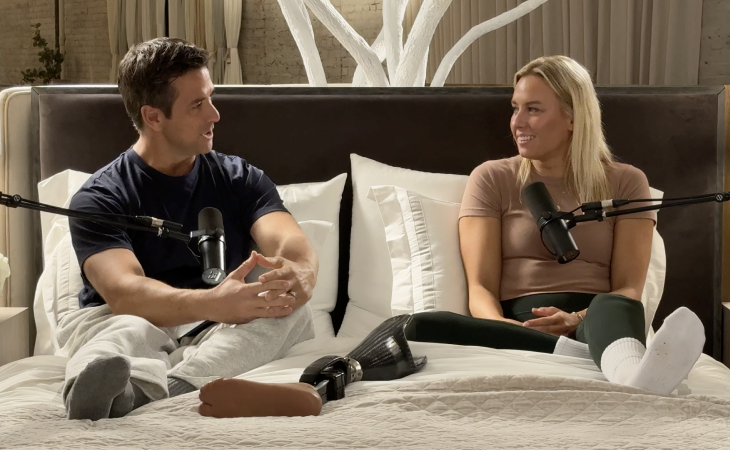
DB: Okay, so let’s just get it out of the way. Here, we have a fifth leg with us. And for those that aren’t watching, those listening, tell us about this.
JL: I have a lot of legs. So these are really special to me, because these, for me, really just allowed me to step into my full self and be confident. So most of my life I’ve worn my everyday legs that look realistic, but these just truly, when I got these when I was maybe 22, around that, they just made me feel so, like this is me, like, my pole legs, I wasn’t hiding, I just felt so confident in them.
Why she shows her prosthetics
DB: You always show your prosthetics. Why?
JB: It took a lot of time, actually. So when I was younger, I actually never showed my legs, and I didn’t like when people stared at me and people would point at me and stuff. And I have always had this option to hide my legs if I want to. But I realized one day, when I was getting a Starbucks, I was like, this doesn’t serve me. If I keep hiding my legs and I just seem so insecure, I notice people kind of fed off my energy. But if I just embraced who I was and just lived life to the fullest, people were so kind. I don’t know how to explain it, but it was a really big moment. So these actually make me really proud, and I do try to wear them all the time when I like wear short dresses or I do events.
A conversation about disability
DB: You seem like the word disabled doesn’t fit you. You seem empowered. Is that the way you feel? Do you feel disabled? Because you sure don’t seem it.
JL: Some days when I have a big flight of steps—steps are always hard. But no, I mean, I think for me, thankfully, it’s all I’ve known, right? I was born without my legs—I did have my legs amputated, I had a foot with three toes that was amputated at 18 months. But definitely, there are moments in my life that I realized that I’m still different. But I think the amazing thing about humans, we’re just so adaptable. So even though I make it look really easy, just like everyone in their sports, right? We make it look so easy. There is a lot that’s going into me walking and adapting from the ground, whether it’s carpet or hardwood floors, right? I’m always aware of everything. But, I mean, there are moments I definitely struggle but just keep moving forward.
Adoption + early life
DB: I love how you skip through your story, although it’s not remarkable. You’ve told your story so many times you’ve forgotten how truly remarkable you are. Do you know that?
JL: Okay, that’s really nice.
DB: You just skipped through being born, by the way, in Siberia to teenage parents and given up for adoption at 13 months.
JL: A baby. It’s so funny that you’re saying that.
DB: Why do you skip through this?
JL: Well, I recently was talking to my husband. I was like, I do a lot of public speaking, you know, sharing my story. And I’m like, you think, is this boring? It’s my story, right? We’re so used to our stories.
DB: It’s not boring.
JL: But yes, I was put up for adoption by a 16-year-old girl in Russia, in a Siberian orphanage, which is just so wild to me. And around that time, my now-parents in Baltimore, Maryland, had to—couldn’t have any more, tried for nine years—they had something called secondary infertility. So they went to a local adoption meeting, and they said they saw my picture. My mom said I was the most beautiful Russian baby—which I really was—and they just said, this little girl in Russia with leg deformities needs to be adopted very quickly. And it’s crazy because, there’s been so much, a lot of therapy, a lot of trying to understand, just comprehending adoption, being born without legs. But my parents were just like, yeah, we just knew. I was like, you knew? But they never saw a picture of my legs. They just knew that I needed to be adopted. So my dad went to Russia—and they like to make a lot of jokes, like, we’re gonna get—they used to say something that was not, like, buy one, get one half off, type of thing. Now they realize that that was not okay.
DB: Appropriate?
JL: Yes, I’m like, Mom—she’s like, I had no idea. But they got another little boy at the same time, so my brother in the same orphanage, Josh, love him. So we came to the U.S. Legs were amputated at 18 months.
DB: At 18 months?
JL: Mhm.
DB: And again, you kind of skip through this as though it’s just ordinary. You obviously don’t have memories of it.
JL: No, but my parents did film all of it. So I have all of it on film, which is so crazy to me. I’ve been able to see myself after that surgery and playing. It’s wild.
Amputation + pain (and still moving)
DB: I mean, given up, not not given up, it’s not the right word, but adopted and had two legs amputated at 18 months. That could have been your story. That could have been it. Instead, it’s 31 Olympic medals, the most decorated Olympian of all time, and 18 golds. If we’d have told that little girl that, she would have said what?
JL: Crazy. Well, I think for me, I knew that I wanted to be just the best, right? I knew that, with my legs and growing up, there was a lot of moments I had to slow down and rest. And I think that was really, really hard for me. When you talk about stories and stuff, for me, I had my first initial amputation, but my parents didn’t know that my leg and the bone would keep growing and it came through my skin, and it would curve, kind of just get really pointy and pop through. And I have this memory one day, I was playing, swimming—wild, swimming—and I lifted my leg up with my knee, and I saw my bone come through. And I remember this. I was like, I just want to keep playing. I don’t even want to tell my parents that the bone came through my skin. And I went and just kept playing and swimming, which is probably with infection, I just didn’t want to deal with it because it was so my norm. And at the very end of playing all day in my grandparents pool, I was like, guys, I think I should tell you, the bone came through. So I grew up with a lot of pain, I grew up with a lot of confusion, I grew up with a lot of trying to understand. And my parents had two more kids after we were adopted. So we’re one of six kids, and my little sisters both had legs, and that was just so hard for me to understand why I didn’t.
Anger as fuel
DB: I would imagine it’d be so easy for you to be this bitter, angry person. You seem to have a light inside you that shines and makes us all want to be better people. Where in the world did that perspective come from?
JL: Yeah, that’s the coffee that I had. No, I’m kidding. Thank you. That was really nice. I definitely had my moments, right? I did not start this way, viewing it in such a way, When I was little, I used to ask my parents why. And that was such a question, and they just didn’t have the answers. And I think that was really hard, and I was growing so much that we just could never get a good fit with my legs, right? I was in a lot of pain, and now, you know, I’m in therapy. I love therapy. I think therapy is so healing. It’s totally taking back just owning my power. But it was just really hard, and anger actually fueled me. I think anger, we don’t talk about it enough, just how powerful anger is as an emotion. Anger allowed me to get through every tough moment, every surgery, climbing on the operating table, seeing the bone come through my leg, getting a new set of prosthetics, seeing kids stare at me, thinking I was the only one on Earth missing legs as a young, a bilateral. It allowed me to get through three hours in practices. But truly, anger is what fueled me, and that didn’t change ‘til years later in my life.
DB: So are we all kind of misinterpreting anger? Instead of viewing it as a negative, should we all view it as a positive, as fuel?
JL: I think there are some moments it’s good. I think honestly, I mean, there were some races that I got up there.
DB: I’m gonna tell my wife that. My anger is fuel. She’s not gonna buy that.
JL: But there are races that I would set behind the block and be angry and be like, you’re not gonna beat me. So, there are moments, I think applied, right? But anger really did help me keep moving forward at times.
Parents who never held her back
DB: You talk about your parents. So they have a double amputee daughter, and instead of, you know, my instinct as a parent would be like, let’s go with chess club, debate, science club, you know, things like that. Instead, they go gymnastics, cheerleading, ice skating, biking, trampoline, rock climbing.
JL: I did a lot.
DB: Why? Instead of taking the easy way?
JL: Yeah, I’m so grateful. So my parents never, ever let me, never held me back, right? And it’s really cute. So when I had my legs amputated, they scheduled a therapy appointment or physical therapy, and they said they canceled it just because they were like, you did not need it. I just figured everything out, and I liked being on the move. And I think that’s because as a little girl, through all my surgeries, I had to rest and recover for about a month. So I would climb on top of the refrigerator, I would swing around the banister. I would roll around. I learned with my cast, I could roll around really fast. So I would just somersault and roll everywhere. But I just wanted to be like other kids. And I had siblings who wouldn’t even allow me to be disabled, right? They just, I had an older brother, an older sister, two older brothers. So they pushed me into doing things too, and I just wanted to do all the sports. And I wanted to always—I just wanted to feel like a kid. I didn’t always want to be the girl with no legs, and that’s what I was for a long time. So when I started playing sports, I realized that I was gaining confidence and I could do things, and I had to try a little harder, but then I was really good and I never gave up, you know.
Childhood + being “different”
DB: So speaking of your childhood, look, kids get picked on for wearing glasses, for having big ears, for wearing the wrong name brand. What was childhood like being a double amputee?
JL: You know, being a double amputee, there were moments it was hard. I never, there were moments it was hard, but I was never really, ever made fun of. I’m so grateful for that. I had a lot of people stare and a lot of people point. And again, right, we didn’t have social media, so I never really saw anyone my age. But it wasn’t until we found out about the Paralympics that truly things changed. But, I mean, I was really protected, I think, looking back. I did struggle with people staring, and I remember one time being in the grocery store and kids were, they were just pointing. And I was like, Mom, I’m gonna go talk to them. I remember saying that. She was like, Jess, let it go. Now, years later, I get it. Kids are curious. They’re always gonna be curious. And I actually feel like I get the chance to go and talk often to little kids that it’s such a full circle moment where I’m like, I get to show you my legs, and they’re just, within 30 seconds, they’re like, okay, cool.
Writing a children’s book
DB: They’re just normal. They’re part of you.
JL: It’s really sweet.
DB: And you wrote a children’s book, Mermaid with No Tail. The theme of it really struck me and seems to encompass your entire life. And what’s that theme?
JL: So, great question. It is, the thing that makes you different is your greatest gift. And I feel like in this world, we really need to hear that—just what makes you different, it’s okay to stand out. And I’ve always felt like I was born to stand out, clearly. But it was really sweet. My dad actually came up with the whole story, and my dad has always been my hero. He’s so incredible. And he would drive me back and forth to some practice, and one time I would just remember him saying, Jess, I think you’re gonna have a book one day. And now I’m like, I have three books. But it was his idea. He came over. I still have all the original notes in my phone. And my dad was hanging up my pictures, and he was like, Jess, I have this idea. And we just started playing with ideas about this mermaid, born without her tail, born without my legs, found by sea turtles. Sea turtles can’t swim. My parents can’t swim—well, my parents never swam. There were just so many cute little details. We really struggled with the name, because we were like, should we name her Aqua or should we name her Tatiana? And I was born Tatiana in Russia.
DB: Yeah, do you still embrace that? It’s still part of your—it’s your middle name.
JL: Yes, this is—
DB: You were born Tatiana.
JL: Do you want to hear this story? It’s really funny.
DB: I would love to.
JL: The other day, we were having lunch, my whole family, and I was like, Mom, why did you change our names? Because it was Denis and Tatiana, and they went from that to Joshua and Jessica. She just says—my mom is so cute—she was like, I just didn’t want you to feel different in school. Because at the time I was gonna be in school. I’m like, Mom, and she’s just giggling. It made sense to her that she didn’t want me to feel different with my name. And we’re all like, legs, like, what are you talking about? And then I ended up being homeschooled. So Tatiana is my middle name.
DB: We still embrace the Tatiana.
JL: Yes, and my husband calls me Tatiana. And sometimes I’ll put it on my Starbucks order, Tatiana.
Swimming: from 10 to the Paralympics Games at 12
DB: Oh, I like that. So at 10, your first competitive swim race, I believe. And then at 12, you’re in your first Paralympics, when most of us are just hoping to get our first kiss and you’re getting your first three gold medals. What pushed you so far that fast?
JL: Yeah, I think again, right, I was the girl with no legs, and when I showed up to the swim team, it was a place that I just didn’t have to wear my legs. Because I was changing so much. They were so uncomfortable that I just needed to feel free. So I’d always love to swim, made sense, showed up at the swim team 10 years old, took off my legs, walk over on my knees, and I just know that, in a way, I had something to prove. And I had an incredible coach, Andrew Barranco, who still works with me to this day, who just—how many coaches at that time, a lot of people weren’t spending time with a little girl with no legs to teach, right? Andrew took hours and hours and hours to work on every part of my stroke. So even though I didn’t have a kick, we found ways to have a strong core, to get my back up where I could grab the water, or my pinky placement. I mean, I’ve been told my whole life—it’s a little bit different now as I’ve gotten older, my shoulders hurt a little bit more—but just that I had flawless technique, which I think really shows with my medal count. I was just always able to swim so fast, but I also had a heart to win. So here I am, made my first Paralympic team somehow, 12 years old, youngest on the team. At the time I didn’t think I was 12, I thought I was 18. But I just remember being so excited to be part of Team USA. And I stepped up for my first race, it was the hundred freestyle, and I was up against the world record holder, and not expected to make finals. Made finals. And I just remember, I’m swimming, I’m swimming. I wasn’t in the first place. I was seeded first, but on the way back, I was not in first place, and the girl twice my age was ahead of me, and I was 15 meters out of the wall. And I just remember just saying to myself, in my head, I mean, I remember it clearly, everything slowed down. I was like, I did not come here to get second, and I touched the ball and won gold by a 10th. And to this day, I’m the youngest Para athlete to win.
DB: Were you oblivious to the magnitude of it all? I mean, from Siberia to Baltimore to you’re in the Athens Summer Paralympics at age 12?
JL: Yeah, I think just because I didn’t really want to be different. I was born to stand out, but at the time, when you’re younger, all I wanted to do was fit in, right? I wanted to wear shoes that I couldn’t wear. I wanted to wear jeans that fit differently. I wanted to blend in at the time, right? And it was just so hard to be different, right? Everything about me was so different, even my birthday, right?
DB: You’re a leap year.
JL: Yeah, so everything.
DB: So you’re eight years old right now, or 10? How old are you?
JL: Something like that.
DB: So your birthday got skipped every year.
JL: But I’m born for the Paralympics. I literally have a birthday during those years. But when I was 12 years old, I just remember my brother being like, Jess, you don’t even have a birthday, or you have a birthday this year. And I was like, what? I just couldn’t feel more different. So, sport, for me, just gave me confidence and made me feel powerful and seen, and just that I could do something. I was just a little bit more like a kid.
Resilience + showing up
DB: What does the word resilience mean to you? How important is that word?
JL: I don’t know, because it’s so interesting, right? You talk about therapy. I love therapy. I think, for me as a kid, I didn’t have a choice to quit. For me, I wasn’t given a choice. I just knew that in order to keep moving forward, in order to not give up, I didn’t have a choice, right? I mean, what would my life have looked like if I just stopped moving, right? But I didn’t have that luxury. I had to climb on the operating table and have my leg amputated because, if not, the bone was going to come through, right? And I tried to put off those surgeries. I tried. I would walk in so much pain. So for me, resilience was just—I mean, I had every reason to quit. I have every excuse. I could use any excuse, right? But I just decided that quitting was never going to be part of my vocabulary option. And there were moments that it was hard, moments that maybe I should have slowed down—maybe I should have as a little kid, right? I was allowed to talk about it with my parents, that I was struggling. But I just chose to keep fighting and moving forward and to prove myself.
DB: What can the audience learn from that mentality? Regardless of what your circumstances, regardless of what you’re trying to persevere through?
JL: I mean, not giving up is so important, right? And I think that people, there’s a quote, I’m gonna mess it up, but like, people that know how close they were to success but they quit or something. I’m messing it up.
DB: I actually can’t nail it.
JL: Okay, but you get what I’m saying.
DB: We’ll fix that up in post-production.
JL: Yes. But, honestly, consistency and not giving up and just showing up is so important. Resilience is just showing up even when you don’t want to, right? It’s showing up for those practices that made me a 31-time medalist. That’s resilience, even just creating these small habits.
Eating disorder + control
DB: Okay, so let’s fast forward to 2016, six medals, one gold. At that point you encountered, you battled through, an eating disorder. Looking back on it, do you know what led to that?
JL: Yes, so great question. I had gone back to Russia and met my birth family. So my birth mom married my birth father, and they had three children after me. And I think around that time, I had just joined training with Michael Phelps and Bob Bowman. I was the only Paralympic athlete with 15 Olympians. And that, to me, was massive because I want to prove that I’m just as good. Because I was so sick of people being like, oh, you’re a Paralympic athlete. And I was like, no, I’m just as good. So around that time—swimming had always been a way to numb the pain, numb the frustration, numb the adoption, numb everything. But a Russian reporter went and found my birth family. So I think around that time, I just never slowed down enough to address it. So going into the 2016 Games, it was my hardest Games. And I just think, for me, everyone wants to feel control. It’s hard for me to relinquish control. But that’s what I gravitated towards, was just food and eating and just, you know, my performance. I had two bad shoulders, everything that went wrong. I remember telling my mom, I wish this was the warm up, going into Rio.
DB: And eating is what you could control?
JL: I think so.
DB: Jesse Diggins told us almost an identical story.
JL: I love Jessie. Yeah, she’s so great.
DB: What helped you get through it, looking back on it then?
JL: Honestly, therapy. And I used to think therapy was such a joke. And my boyfriend, now husband, at the time, was like, Jess, I think you should do this. And actually, his sister went to my now therapist. But she was the one recommending, like, Jess, you would be perfect. She was in the process of adoption. I just felt like it was meant to be. And I still talk to her. I dedicated a part in my book to her. But this vulnerability, right, when we talk about superpowers, to me, I never showed weakness. I think I was 16 years old with my surgery, and I reached for my dad’s hand, and I was like, please. I’m just in so much pain. And that was huge for me. So vulnerability came from therapy and knowing that that is so powerful. And I think too, I want people to know all of me. I don’t want you to just care about the swimming. Swimming is great, but I’m so much more than just a swimmer, and that came from years of therapy and opening up. And it’s still very hard to get in there and, be like, oh—.
DB: That was 2016. And then the lead up to 2020 in Tokyo, you said several times, this is my final, my fifth and final Olympics.
JL: Wow. You did your research.
DB: We are still looking at your seventh. Did you mean it? And what changed?
JL: Did I mean it? I don’t, it was just so hard—life, it was just so—I have gotten to stand on the podium, on tops at that point, like 12 or 13 times? I was up there, and it’s like, how do you keep realigning your goals, right? When you’ve done it, you’ve achieved it. I felt like at that point I was still so good at my sport. And I think for me, it was just, there’s always a post-blues after every Paralympics, every Olympics, right? I think so many athletes go through that, and we’re now just talking about mental health and how important is to get help. But for me, I think at that point I was just like, I’m done. What else do I have to prove? It demands everything of you, right? The sacrifice—I’ve learned to turn sacrifice into purpose. It was just around that time I was like, I think I’m good. And it’s so funny because I said, after the—in Tokyo—I won a silver in the 400, I was like, I’m never doing that again.
DB: That’s it.
JL: And I went and swam it in Paris and won a gold. Maybe I should stop saying—.
Post-games blues + mental health
DB: You mentioned the post-competition blues. Some would look at that as depression, and I know you have embraced antidepressants—therapy, antidepressants, myself—so, meditation, all of it. Why do you embrace that and talk about it publicly?
JL: It’s really interesting, right? Because, as a girl with no legs, I want to do it all on my own. I want to show the people that I can do it, that I can handle it. But there is this freeing moment when I’m just like, I don’t have to do it all on my own anymore. I have this amazing support system. I have people who care, and it’s okay to not always be okay, right? We’ve heard that quote so many times. But that, to me, was just saying that, it’s okay, you are so tough, Jess, but there’s strength in recognizing when you need help. And I think for me at that time—I feel like when I look back on my life, I was always in this fighting moment, I was ready to fight, and it was just this freeing moment when I could just say, I’m struggling, and it’s okay. And yes, I’m still taking medicine, I still love it, I still know that I need it, and that’s okay. And it’s helped me through so many different seasons of my life. And you know, maybe I’ll go off of it, maybe I won’t. I just know that this is the best version of me when I’m taking care of my mental health.
DB: I tried to go off of it several times, and it’s not fun.
JL: My husband’s like, you should go back on that.
DB: Yes.
JL: Truly, when I first started taking medicine, the very first day—and I know there’s all sorts of stuff—I remember laughing for the first time in that week, and I was like, oh my gosh. I was like, is this how people, and I had always been so confident, full of life, but seasons—everyone’s gonna go through different seasons of life, and it’s okay, just when you need help.
What swimming feels like (without prosthetics)
DB: Can you take me through the feeling of swimming for you, when you take off your prosthetics? If it’s a 50-meter free, can you just describe that feeling from diving in to touching that wall?
JL: Okay. The feeling.
DB: Take yourself there.
JL: It’s just almost—I keep hitting the mic—It’s almost just like, I have so much weight on me, right? Imagine just this weight, and I feel a tangible weight. I get to sit down, I take off my legs— the thing that doesn’t stop me but makes me realize that I am different, right? I have the weight of my legs, and I stand on the edge of the block. I always get as close as I can, and I just jump in, and it’s the sound of the water, the smell of the water, the power of the water. It’s just, it’s like a glide, and it’s so free. And you can’t hear anything, really. You just hear the splashing of the water. But I engage every little muscle. I know how to tuck my ribs and reach and extend and breathe. I just feel so, so, so unstoppable. And I don’t feel that on my everyday life, right? Every day, I wake up and I put on my two prosthetic legs and I take on the day. But in the water, there’s nothing else that makes me feel like I’m flying, I’m free, I’m powerful. I don’t know, it’s the most freeing experience I’ve ever felt. And people love swimming, right?
DB: And when you reach out and touch that wall and you look over to your right and to your left, what is that feeling of knowing you—?
JL: I think now, as I’ve gotten older, it’s a little shocking, because I’m like, I’m still winning, this doesn’t make any sense. But I just realized that—I was so good—you just don’t know when you’re fast, right? And I had a coach tell me that when I was younger, and I was like, you’re never gonna understand until you’re not going these times. And in Paris, I won two gold, but I didn’t go best times. But it’s so cool to look back and see how incredibly fast coaches had gotten me with what I had. But it is this amazing feeling when you reach and you touch the one, you’re just like, how does this keep happening? And I do think it comes from a place of just, showing up, never giving up.
Sleep routine + naps
DB: Part of that, what makes you great, I assume, around Olympics time and training is the power of a good night’s sleep. Do you have, like, a sleep routine? Do you have a sleep story? Take us through it.
JL: I love sleep. It’s a secret weapon. It is my thing. I need sleep. So when I’m training, I will swim two hours in the morning. I’ll eat as fast as I can, I’ll take an Epsom salt bath, and then I jump in my bed. I’m like, a napper for three hours—I wake up, and then I literally go back to the pool. So I am in a deep sleep where I wake up and I’m like, I don’t even know what day it is. I sleep on my back because my shoulders hurt so bad. I can’t sleep with my arms up. I just need to feel rested and recovered. I mean, it’s been proven that sleep is the best recovery.
DB: You take a three hour nap?
JL: Yeah. You know what? You should come to one of my two-hour practices, and then you will nap so hard.
DB: I love the power of a nap. I mean, I believe, even if it’s 20 minutes, I am all in on a good nap. Now that you’re married, do you do anything odd, like talk in your sleep or snore or swim?
JL: I didn’t think I snored, but my husband just filmed a video of me snoring the other day. And I was like, delete that.
DB: He filmed you?
JL: I think I was just really tired. But I got my tonsils out, so I was like, I don’t snore anymore. But, yeah, it must have been. I mean, I was in a deep sleep, but he has that on his phone if he ever needs to use it.
DB: Wow. I hope my wife never does that. That is blackmail material.
JL: And it’s funny, because if he ever snores, I’m like, punch him. I’m like, stop that.
DB: Yeah, that’s what she does. So when you’re not training, do you still sleep that well, or do you have the struggles that the rest of us do?
Snacks in bed
JL: No, I have learned, climbing into bed—I need a lot of me-time in bed. I have snacks in bed. I watch shows.
DB: Hold on. You have snacks in bed. What kind of snacks?
JL: A little charcuterie board.
DB: You have a charcuterie board?
JL: Yeah.
DB: I need a photo of this, please.
JL: I put on my little robe. I love multitasking, so I have a face mask, it’s all of the things—and I’ll just eat my little olives and cheese and stuff.
DB: Olives and cheese?
JL: I honestly, that’s one my favorite things to do, is—I make the charcuterie boards for family events. I have all the pretty books, and I try to make it as pretty as possible. But yeah, to me, I love climbing into bed. I have a whole routine. I like reading, I like phone time. Yeah, I really love my bed.
DB: That is remarkable.
JL: Have you never eaten in your bed?
DB: I don’t think I’ve ever eaten a single thing in my bed. No, I can’t ever recall that. I have brought the occasional glass of wine to bed, which I think is a terrible idea, because it literally is the one thing that disrupts sleep more than stress. Do you ever bring wine with the charcuterie board?
JL: I have in the past. But I bring, like, a little—
DB: Oh my gosh, bed party.
JL: I realized I’m not sleeping well. Yeah, I do a little Spindrift or my water.
Music + pump-up songs
DB: What about streaming music? Do you have a playlist? What artist is playing when you’re—?
JL: In bed?
DB: No, going ito the pool, when you’re getting ready to compete?
JL: I just listen to the same songs over and over again. I don’t feel like I have the energy to always search for new artists. But I love, Rihanna, “Umbrella”—some of her old stuff is so good— before I walk out. Celine Dion, I’ve walked out to before. Some intense stuff. I love Ava Max.
DB: I don’t know Ava Max.
JL: She’s the one that sings, “Sweet but a Psycho.”
DB: Okay.
JL: Because I’m like, ooh, I’m sweet, but I’m a psycho when I swim.
DB: That really applies to you, doesn’t it?
JL: Uh-huh. So I’ve found that in swimming, so many good breakup songs translate well to me and my relationship with the pool, because it’s this crazy relationship, right? I have highs, I have lows. It’s abusive.
DB: Only one artist comes to mind when I think about breakups and music. Taylor Swift must be the poster child of this.
JL: I do like her one song that just came out, the top one, “Ophelia.”
DB: “The Fate of Ophelia”?
JL: Yes, I really like it.
DB: That’s a great song.
JL: It’s so catchy.
DB: You’re not a Swiftie though, I don’t think.
JL: I don’t know. I don’t think so.
DB: Okay, I am a self-proclaimed Swiftie.
JL: I did see her in concert, though.
DB: Was it remarkable? You saw the Eras Tour?
JL: No, I saw her before that.
Favorite apps
DB: Oh, you saw her before. Okay, so if, if there’s one app you could have, just one app, what is it?
JL: Oh, geez. Nobody’s ever asked me this before.
DB: Hmm.
JL: Well, what would you say?
DB: Well, I’d probably say, as much as I hate it, I love it. Instagram allows me to see friends, see family, get news, see hilarious golf videos, whatever you want to have, it’s generally there. I know there’s a lot of—
JL: I really like TikTok.
DB: TikTok?
JL: TikTok, yeah.
DB: You do some fun TikToks.
JL: I know. I haven’t done enough.
DB: In particular, with your legs.
JL: So that’s when I started it. I felt like it was a way to just almost educate people about prosthetics. And my first or second video back in the day, when TikTok was really taking off, I think hit 36 or 37 million views. And I was like, oh, this is cool. We all got on TikTok. But I like TikTok for recipes, because I need a lot of visuals when I cook.
“Mary-Kate and Ashley”
DB: Okay. I love how you show and you call them nubs or hot dogs, your legs.
JL: My little nubbies.
DB: You seem to laugh at them.
JL: I actually name them.
DB: Oh, you name them. What are their names?
JL: Now, I’m gonna get them confused. So this is my short little—
DB: You’re forgetting the names of your nubs, your legs.
JL: This is my short little chubby one.
DB: Okay.
JL: So I don’t have a lot of bone on this side. So if you really see them, she’s just kind of short. She’s cute. But this is Mary Kate and this is Ashley.
DB: Mary Kate and Ashley.
JL: They’re twins.
DB: Of course, the Olsens. Where did that come from?
JL: I loved Mary Kate and Ashley when I was younger, and I was just like, they’re my twins. They’re my girls. I have called my parents up before and been like, Ashley’s sore. I talk about them.
Guilty pleasure + ice cream discovery
DB: I love this. Do you have a guilty pleasure, like something that you would pig out on if you were not training, like something that you would—on a cheat day?
JL: I love Thai food.
DB: Okay, that doesn’t sound bad at all.
JL: Oh—
DB: Oh, you have one.
JL: So this is wild. I’m not kidding. I discovered ice cream this year. I come from a very holistic family.
DB: Hold on. You discovered ice cream?
JL: This is gonna sound crazy. I mean, it’s the year after the Games, so—but I’m telling you, I like brownie batter. I like all this brownie batter, and there’s this ice cream that they make in Baltimore, and we found it. And I’m telling you, I’ve had way too many pints of ice cream, more than I’ve probably had in my entire life, this summer.
DB: Who is it? Do you know the name of the ice cream place?
JL: It’s called Always Ice Cream.
DB: Always Ice Cream?
JL: Yeah.
DB: How did you go win 31 medals before discovering ice cream?
JL: I don’t really like a lot of sweets.
DB: Truly bizarre.
JL: So if I were to do sweet, I would do some chocolate pretzels. I don’t know, wine was always my dessert at times. But I don’t really do that anymore.
Michael Phelps
DB: I know you don’t have a celebrity crush, but you probably met your hero very early. Michael Phelps. You’re the only person, I think, on the planet, with more medals than Michael Phelps. He has 28, you have bragging rights.
JL: But not golds.
DB: He does have you in that—23 to 18, I believe. So what did it mean to meet him? He’s a character in your book—Phelpsy—and what has he meant for your journey?
JL: I think Michael is truly one of the greatest people I’ve ever met. Obviously, an incredible athlete, but I think just as a person, he is incredible. And he has taken time, even just for me as a Paralympic athlete—and that speaks volumes, right? Because I’ve grown up in the in the world of Paralympics in 2004 to where it is now—where, you know, who would have ever thought I would have a Super Bowl commercial as a Paralympic athlete? Because back in the day, that was unheard of, right? So, in 2004, I remember doing an interview at 12 years old with the Baltimore Sun, and they asked me who I really wanted to meet. I said Michael Phelps, and I was supposed to meet him at a parade, a Baltimore parade, and something came up. But his mom, Debbie, sent me an entire basket of signed stuff. And I was like, this is so cool. But years later, I’ve done events with him from being from Baltimore and then had the opportunity to train with him, which is so crazy, and for the Rio Olympics and Paralympics. And I think just respecting the hard work, getting to see it in practice. But he did write the cover for my book, which is really special, because I don’t think he’s ever done that for anyone else. I don’t know.
DB: No, that’s truly remarkable.
JL: I was like, thanks, Michael.
Bringing it back to adoption
DB: So let’s take you back to—the word adoption can mean a lot of things, but I think it is both a blessing and a curse. How do you see it?
JL: It’s such a good way to put it. So for me, with years of therapy, I’ve learned that it’s not just black and white. It’s okay to live in the middle, it’s okay to live in the gray area. And it’s really hard, right? I have these moments where I’m like, oh my God, nobody asked me as a 13-month-old if I wanted to be adopted, right? I have these crazy thoughts where I’m like, what would my life have looked like in Russia? And it’s really hard, because sometimes people will be like, oh, it would have been terrible. It would have never looked like this. And that’s hard, because it’s like, well, I still didn’t have a choice, and I didn’t have the choice to decide. And I later found out that my birth mom said she planned to come back and adopt me, and that she actually never even wanted to give me up. And that’s hard, right? Because it changes everything in my mindset when I was little, thinking I wasn’t wanted. And that’s wild that she had me for four days, which means that I attached to her for four days, and then she said she had to leave me there. And there’s so many little bits that I just don’t understand, right? Even though I’ve heard this—my own story—that’s just hard for me to comprehend. So I still talk to my birth mom, because I met her for the first time when I was 21? It was crazy. But it’s really hard because I love my family, but I’m the only blonde. I know I’m adopted. There’s still that moment where I’m like, oh—but my parents have never treated me, nobody’s ever treated me differently. But some days that’s hard.
DB: But aren’t you grateful for the adoption? I mean, would your life have been unfolded anywhere near the way it has?
JL: Yes, but sometimes that can take away that it still hurts, right? I don’t always just want to be grateful. I’m grateful, and I’ve been able to open up a lot with my parents that I love you, but it’s still really, really hard. I want to be able to feel all those feelings that—it’s not that I don’t love—but there’s moments that it’s just that it’s just still really hard—especially because I met my family.
DB: This is the blessing and the curse part of it.
JL: Exactly.
A different life
DB: Have you ever thought about what life would be like if you were born with two regular legs?
JL: Yeah. I mean, wild. There were days when I was little, and I was going through the surgeries and the uncertainty and the pain and the infections, that I would wake up and I would just look at my legs and pray, please just grow back. Because I would see so many other people not having to have challenges. It’s so hard not to think that I’m being punished. That’s what I felt. And my surgeries too—going back to the beginning—when I would have the bony overgrowth, there would be draining tubes in my cast. And I don’t know why, but after the surgery, they would rip the draining tubes out, and it was the most excruciating—it was just so painful. So yeah, I would wake up and be like, what would it be like to have legs? But then I got to a point where I was like, okay, I fully embrace who I am. And I think when you can just accept yourself—but at the same time, I’ll never have them, so time to just keep moving forward.
Rapid fire questions
DB: All right, so let’s move forward and land this plane softly. Aisle or window?
JL: Oh my gosh, I am an aisle girl.
DB: Every time? You don’t like to sleep against the side of the plane?
JL: No. I drink a lot of water on planes so I always have to go to the bathroom. Hydration. I’m an athlete. But I also like to get up a lot because my knees will fall asleep, and I like the extra aisle.
DB: Okay, I didn’t consider that. This will be your seventh Olympic Games. Favorite international city or city that you visited.
JL: I really loved competing in Australia. That was so fun. It was just a great meet. I don’t know, it was the best.
DB: Sydney was amazing. Bucket list destination that you still haven’t been to?
JL: I haven’t been to New Zealand.
DB: Okay. You can do that after the 2032 Olympics. It’s right next door. I highly recommend seeing Auckland.
JL: I’ll just go as a non-athlete.
DB: Okay, fair.
JL: Bring cute outfits for once.
DB: What’s your Starbucks order?
JL: It’s really boring.
DB: Oh, okay.
JL: But I get it every day. Well, so here’s the thing, when I’m at the pool, it’s my office. And, I cannot tell you how many—my teammates are athletes—have been like, what are you doing with your—it’s on top of the pool deck. I love coffee. I don’t know if my nutritionist likes that I have the coffee there, but—
DB: You love coffee.
JL: I do.
DB: What’s your order? You didn’t—
JL: That’s because I would train so much. I needed something. I just get iced coffee.
DB: Straight up, black? Cream, sugar?
JL: A little bit of cream. But I have to do it.
DB: Because if they do it, they’re gonna make a milkshake out of it.
JL: It’s too much. Yeah.
DB: Okay, fair.
JL: Extra ice.
DB: Mine’s boring too. I’m a black cold brew guy, straight up. Cold brew will change your life.
JL: It gives me headaches.
Yahtzee in bed
DB: All right. Last thing is, I hear you are competitive at everything.
JL: Oh no, what are we gonna do?
DB: Including Yahtzee, that’s the word.
JL: How do you know that?
DB: Oh, I do my homework, honey. I do my homework. So we are going to do one roll.
JL: How do you know this? This is crazy.
DB: I do a lot of homework.
JL: Did you write my husband?
DB: This is it. Gold or bronze. There’s no silver. I have a gold medal and a bronze medal. We get three rolls. We’re gonna see—
JL: We actually call the bronze medal the rosé metal.
DB: Okay, then it’s gonna be gold or rosé. You go first. You get the typical three rolls. We’re gonna have to play like poker.
JL: Yeah, but I have no control over this.
DB: What do you mean you have no control over this?
JL: I mean, the dice. It’s not like I can do rock/paper/scissors and read your mind.
DB: Let’s go. I’m gonna film and see how you turn mount here. [Jessica rolls dice] Three ones.
JL: That could be a full house, which is 25 points.
DB: You’re not gonna roll for a Yahtzee? That says a lot about your mentality.
JL: So I need to get a Yahtzee?
DB: No, just the best hand.
JL: But then I could have done a full house.
DB: Hey, man, make your decision. Are you going for a full house or a Yahtzee?
JL: You’re talking. I’m gonna lose. Ones are so low. Full house.
DB: Full house.
JL: How many points is that?
DB: That is tough to beat.
JL: Do you know how many points that is?
DB: I want to say 25?
JL: Yeah, you’re right.
DB: Okay, my turn. I don’t think I’m gonna beat a full house. I’m nervous.
JL: You could get—what’s all the—okay, well that’s not—
DB: Okay, I got—
JL: Two, three four—okay, you could do also a full house.
DB: Oh, wow. I got three fives. I think you are going down.
JL: Yeah, but how do you calculate it?
DB: I’m gonna keep the well, we’re gonna, we’re gonna figure this out. If I have fives over anything, I’m gonna beat you. So now I’m rolling for Yahtzee.
JL: Because then you only have 15. You don’t count the others.
DB: Okay, this is a big roll.
JL: I might have just made that up.
DB: This is a big roll, Jess. Oh, I almost—now hold on.
JL: You have 20.
DB: I have four of a kind. Four fives—
JL: Is still 20.
DB: Does that beat a full house?
JL: No, because that’s 20.
DB: Does four fives beat a full house?
JL: I don’t think so.
DB: I think in poker, four of a kind would—
JL: It doesn’t.
DB: No, you’re going with—
JL: So on the points, at least the way I always, I would put—are you gonna put that in your fives or your fours?
DB: That’d be my four of a kind.
JL: Then it’s 20.
DB: So 21.
JL: Really? I never counted this.
DB: You add up all the dice.
JL: But that’s still lower than 25.
DB: I think you beat me, then. I think you beat me. So you get the gold medal. I get the rosé.
JL: I’ve wanted this one.
DB: Gold. This is what, your 19th gold?
JL: I think this has been sold out because it’s so popular.
DB: 19th and definitely your favorite gold.
JL: Is it over your eyes?
DB: Yeah, is yours?
JL: Wow, it’s weighted.
DB: Okay, night, night.
JL: Oh, I’m bringing this to LA.
In closing
DB: Jess. Tatiana. Thank you for being here. Let’s go night, night.
JL: Okay—but I normally take my legs off.

Saatva Editorial Team
The Saatva Editorial Team is comprised of writers and editors who specialize in creating content about mattresses, bedding, and sleep.
Related Stories


Table of Contents
