
 Why Do I Wake Up Before My Alarm?
Sleep Disorders & Conditions, Sleep Health
November 17, 2026
What Can a Maintenance of Wakefulness Test Reveal About Your Daytime Alertness?
Written by Risa Kerslake, RN, BSN
Key Takeaways:
- The Maintenance of Wakefulness Test (MWT) is a daytime clinical exam that objectively measures how well you can stay awake in a quiet, dim room.
- Doctors commonly use the MWT to evaluate whether a sleep disorder treatment is working or to assess alertness in individuals with safety-sensitive jobs.
- Unlike the Multiple Sleep Latency Test (MSLT)—which measures how quickly you fall asleep during nap trials—the MWT instructs you to resist sleep across four 40-minute daytime sessions spaced two hours apart.
When you think of a sleep test, you might think of what’s called a sleep study, known as a polysomnography (PSG), which is an objective clinical evaluation of how you sleep at night.
But there are other types of sleep tests, including ones that happen during the day. One of those tests is called the Maintenance of Wakefulness Test (MWT).
We’ll cover what the MWT measures, why you may need one, what happens on the day of the test, and how it’s scored.
What is the Maintenance of Wakefulness Test (MWT)?
The Maintenance of Wakefulness Test (MWT) is an objective clinical measure of how well you can stay awake during the day in a quiet, dim room.
It’s often used to check whether a treatment for a sleep condition is working, or to evaluate sleepiness in people who have safety-conscious jobs.
It’s different from a PSG because instead of asking you to sleep at night, the MWT asks you to remain awake during the day.
The test includes four 40-minute trials, or sessions, spread across one day.
What’s the difference between the MWT and MSLT (Multiple Sleep Latency Test)
The main difference between the MWT and the Multiple Sleep Latency Test (MSLT) is that the MWT measures your ability to resist sleep, whereas the MSLT measures your sleepiness.
The MSLT is a daytime test that healthcare providers use to measure how quickly you fall asleep, and whether you enter rapid eye movement (REM) sleep—the dreaming stage of sleep. The faster you fall asleep, the greater the likelihood you are to be excessively sleepy during the day.
Here are some of the key differences between the MWT and the MSLT:
| Feature | MWT | MSLT |
| What it measures | How well you can stay awake | How quickly you can fall asleep |
| What you’re told to do | Try to stay awake | Try to fall asleep |
| How it’s performed | Four sessions (about 40 minutes each) spaced two hours apart, possibly right after you have a PSG | Four or five nap trials (about 20-35 minutes each) spaced two hours apart, usually after an in-lab sleep study |
| Room Setting | A quiet, dimly lit room where you’re sitting in a comfortable chair | A quiet, dark room where you lie in a bed |
| Interpreting results | Fallling asleep in less than eight minutes across trials indicates excessive sleepiness | Falling asleep in eight minutes or less indicates excessive sleepiness; for narcolepsy, also entering REM sleep quickly during two or more naps |
| What it’s looking for | Occupational safety and driving alertness; evaluating a sleep condition’s treatment effectiveness | Diagnosing narcolepsy or idiopathic hypersomnia; sometimes to evaluate the treatment effectiveness of a sleep condition |
Why doctors order an MWT
There are two main reasons why you might get an MWT: for occupational safety or to evaluate if a treatment for a sleep disorder is working.
Your provider might want you to do an MWT if you have an occupation that requires you to be alert for safety. These can include pilots, commercial truck or bus drivers, and train operators.
When taking the MWT for employment regulations, failing the test might mean you get placed under supervision or removed from your job until the problems with staying awake have been addressed.
An MWT can also be ordered to see how well a certain treatment is working if you have a sleep condition that causes daytime sleepiness, including narcolepsy, idiopathic hypersomnia, or obstructive sleep apnea (OSA).
What to expect during the test
The MWT consists of four 40-minute trial periods spaced two hours apart. The first session will start about 1.5 to 3 hours after you wake in the morning. This means you’ll spend a large part of your day at the sleep center.
On the day of the test, don’t use cannabis, consume alcohol, or take sedating medications. Eat a light breakfast at least an hour before the first session and a light lunch after the second trial has ended. Wear comfortable, loosely fitting clothes.
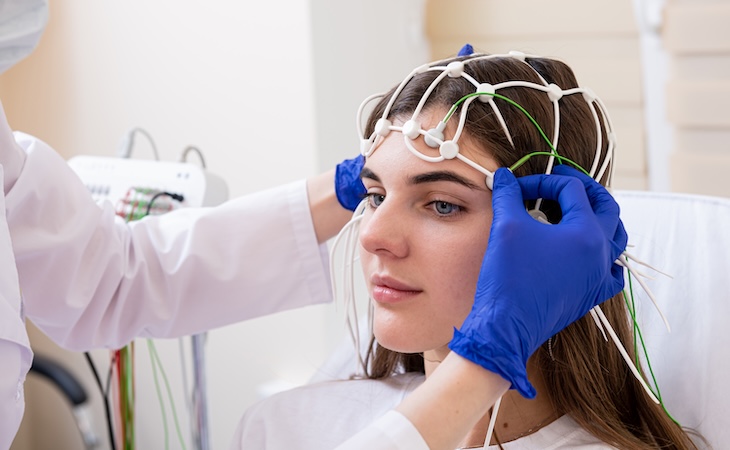
You’ll sit in a quiet temperature-controlled room with low lighting, usually in a comfortable chair with your back and neck supported. The technician will place electroencephalogram (EEG) electrodes on your head and scalp, which will monitor brain waves during the test.
The technician will ask you to move your eyes or keep them open for 30 seconds, blink, and clench your jaw. This is to make sure the equipment for the test is working as it should.
Now your only job during the test is to stay awake.
Unfortunately…an MWT is boring. You can’t talk to yourself, sing, or make any other noises to stay awake (or entertain yourself and others around you). So, engage your brain with silent mental exercises like math calculations, reciting lists, or planning out your next trip. This is probably not the time to be practicing meditation because it can make you sleepy.
While you can’t read or listen to music during the testing periods, you can bring something such as a book to keep you occupied in between sessions.
You can also use the bathroom between sessions, but likely you won’t be allowed to go outside.
The test ends after 40 minutes, or you show three consecutive 30-second stretches of light sleep or one stretch of deep sleep.
How MWT results are scored and interpreted
A sleep specialist will review your scoring, and it’ll take about two weeks before you get the results. Your provider (either whoever ordered your test or a sleep doctor) will review your results with you alongside your symptoms and medical history and determine what the results mean for you.
The main number they look at is your sleep latency, or how long you take to fall asleep during each trial. Doctors combine the four sleep latencies from the four trials into an average sleep latency. If you don’t fall asleep during a trial, 40 minutes is used for that trial.
So what counts as normal? Over 98% of people who don’t have any sleep issues stay awake for an average of eight minutes or more for each trial, so falling asleep in an average of less than eight minutes is considered abnormal or indicates you have excessive daytime sleepiness.
Most people (40% to almost 60%) who don’t have any sleep issues will stay awake for each of the 40-minute sleep trials.
How to get ready for your MWT assessment
Your healthcare provider might ask that you keep a sleep diary for two weeks before taking the MWT. This is because they want to see how well you’re sleeping and make sure you’re adequately rested before the test.
If you have already been diagnosed with a sleep condition such as sleep apnea or narcolepsy, your provider will want to make sure your symptoms are under control. If you use a CPAP (continuous positive airway pressure) machine for sleep apnea, for example, your provider will ask that you use it the night before the test.
Some people need an overnight sleep study (PSG) the night before the MWT, and your provider will let you know if you do. A PSG may be helpful if your provider suspects a sleep condition you’ve never been tested for. The MSLT, on the other hand, usually requires a PSG the night before.
You can continue taking your usual medications, including prescription medications, over-the-counter medications, and supplements with your provider’s approval. You shouldn’t adjust the doses of your medications within two weeks before the MWT. This includes medications that either help you stay awake or ones that help you fall asleep.
Talk with your healthcare provider about your medications and whether you need to make any changes before your test. It’s also a good idea to ask your provider about how much caffeine you’re allowed to consume before the MWT.
FAQ
What’s the difference between the MWT and MSLT?
The MWT measures how long you can stay awake when you try to, and it’s often used to check how well a treatment is working, or to assess alertness for certain types of jobs where it’s important to stay awake. The MSLT measures how quickly you fall asleep when you try to, and is commonly used to diagnose narcolepsy or hypersomnia.
How long does a Maintenance of Wakefulness Test take?
The MWT includes four trials that are 40 minutes each. Each trial is spaced two hours apart, so you will spend most of your day at the sleep center.
What should you avoid before a Maintenance of Wakefulness Test?
Avoid alcohol, cannabis, and caffeine as well as sedating medications before the MWT. Follow your provider’s instructions on any medications you should stop taking before the test.

Risa Kerslake, RN, BSN
Registered nurse
Risa Kerslake is a registered nurse from the Midwest and has worked as a freelance health writer for over a decade. Her work covers health, wellness, and parenting.
Related Stories
-
Why Do I Wake Up Before My Alarm?
-
 How to Sleep Better With Ankylosing Spondylitis
-
 How to Sleep Better With Piriformis Syndrome
Table of Contents
