
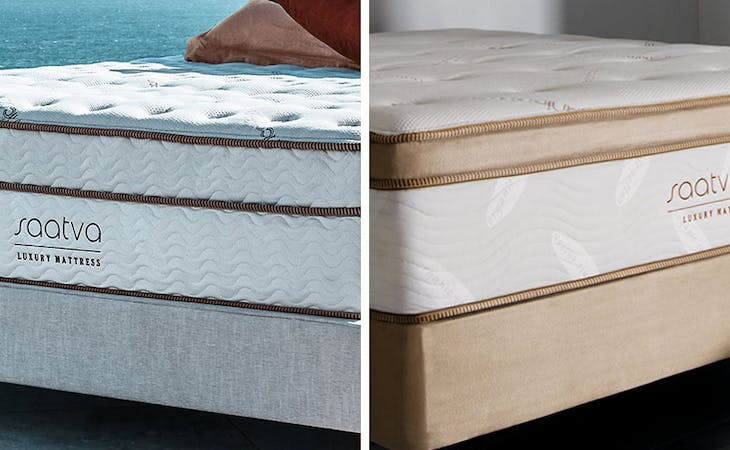
 Saatva Classic vs. Saatva HD: 8 Key Differences
Key Takeaways:
- Back or side sleeping is best for ankylosing spondylitis—avoid stomach sleeping to prevent neck rotation and lower back arching, and use pillows under your legs or a rolled towel at your waist to keep your spine neutral.
- Choose a medium-firm mattress that balances support without forcing your spine out of alignment, paired with a non-contoured shredded memory foam pillow to gently cradle your head and neck.
- Gentle pre-bed stretches (like lower trunk rotations) and evening heat therapy—such as a warm bath or heated pad—help calm joint inflammation and minimize morning spinal stiffness.
Ankylosing spondylitis pain doesn’t pause for bedtime. In fact, many people find their stiffness is worse after a night of sleep.
Below, we cover the best sleeping positions, mattress and pillow tips, and simple evening routines to help you rest easier and wake up feeling as good as possible.
Understanding ankylosing spondylitis (AS) and nighttime spinal stiffness
Ankylosing spondylitis (also called axial spondyloarthritis, or AS) is an inflammatory disease that primarily affects the lower spine.
If not treated properly, this condition can cause the vertebrae in the spine to fuse together, reducing flexibility and increasing symptoms.
Common symptoms of ankylosing spondylitis include joint pain and stiffness, mostly in the lower back; inflammation of the eye; fatigue; weight loss; and skin rashes.
While researchers don’t know the exact cause of this disease, genetic and environmental factors both seem to play a role.
If you notice that your pain and stiffness is worse in the morning, this is completely normal for conditions like AS.
“When the body is moving, you’re getting joint fluids distributed, which helps with keeping inflammation down, explains Mallory Behenna, PT, DPT, orthopedic physical therapist at Brooks Rehabilitation. “The muscles are able to move and pump blood through them to help them not be painful too.”
When you’re asleep—lying in one position or just a couple of positions throughout the night—it’s easy for your joints to get stiff because you’re going for several hours without moving.
Your body is in the same position for a long time, so you’re not getting the benefits of movement like you do throughout the day.
Recommended sleeping positions (back sleeping vs. side sleeping)
Researchers haven’t found evidence that sleeping position changes the shape of the spine over time. But posture during sleep is still critical for AS patients: Holding the spine and neck in strained positions for hours on end can make morning pain and stiffness worse.
That’s why Behenna doesn’t recommend stomach sleeping.
“That puts not only the lower back in an arched position for a long period of time, but then it puts the neck at an end range of rotation,” she says. “The fact that the head has to stay turned one way or the other for so many hours at a time, that can be really painful.”
She also explains that sleeping on your stomach can increase your lordotic curve—the inward curve of your neck and lower back. When this curve becomes too exaggerated, you’re going to experience additional pressure on your spine and worse pain.
Sleeping on your back might increase your lordotic curve too.
“Sometimes the weight of the legs and the femurs as they attach into the pelvis, that can kind of draw the pelvis down,” says Behenna.
To mitigate that, place one pillow underneath your femurs all the way up to where your thighs meet buttocks and another pillow down on the weight of your lower legs. This can help keep your “sit bones” from rolling forward and arching the lower back.
If you like to sleep on your side, be mindful of the area between your pelvis and waist that’s not supported. The pelvis can tip down toward the bed, causing your spine to curve.
“I usually recommend a hand towel, scrunched up, to fill in that little space where the narrowness of the waist is,” says Behenna.
Mattress and pillow selection for inflammatory arthritis
While everyone’s body responds differently to different mattresses, the best mattress for ankylosing spondylitis is most likely a moderate firmness with added postural supports while sleeping (like the pillows under your legs or the hand towel).
“Take your time when you’re in a mattress store,” Behenna advises. “Really try to lay on something for long enough to see, OK, can I lay on here for three to five minutes and start feeling any kind of inflammatory response to that?”
A soft memory foam mattress may not provide the support you need when you sleep. Getting out of bed also could be more work than what it’s worth.
But a mattress that’s too firm will be trying to push the body into a straighter position than what your spine currently allows.
“So really, you want something kind of right in the middle,” Behenna summarizes.
When choosing a pillow, make sure to pick something that will support not only the weight of your head but also the curve of your cervical spine.
Look for a pillow that has not been pre-contoured. Everyone’s body is different, and these pillows are usually made in a one-size-fits-all factory.
Shredded memory foam is another helpful pillow feature to look for.
“Regular memory foam is going to push back against the head and neck just a little bit more than what we want,” says Behenna. “We really just want the weight of the head accepted, not pushed back on. But the shredded memory foam gives you that similar density, like a good support.”
In regards to pillow thickness, your goal is to support your head where your neutral is. When you’re lying on your side, you should be able to draw a straight line from the top of your head down through your face and down the middle of your body.
Whatever pillow you end up with, you can also take the corners of the pillow and pull them in front of your shoulders instead of leaving them behind your back. That can help fill in the space between the back of your neck and the pillow.
Evening warmth routines to reduce morning ankylosis/stiffness
Incorporating some gentle movement before bed can help calm down anything that’s feeling extra irritated after a long day.
Behenna recommends the following nighttime stretches for ankylosing spondylitis:
- Lower trunk rotation: Lie on your back in bed with your knees bent and feet flat. Slowly rock your knees from side to side. “The lower part of the spine is what moves first. You’re moving really slowly and making sure you’re not moving into painful ranges,” Behenna explains. Do 20 repetitions total.
- Thread the needle: To help with pain and stiffness between the shoulder blades, bend slightly forward at the hips and rest one hand on the counter. Lift your other arm and reach it across your body under the opposite arm. Rotate your trunk toward the same side and hold for several seconds. Then slowly “unwind” and rotate in the opposite direction, lifting your arm toward the sky. Do five to 10 repetitions per side.
- Hamstring stretch: For a gentle, lengthening hamstring stretch, sit on the edge of a chair and straighten one leg in front of your body with your heel on the floor. Bend forward from your hips. Hold for 30 seconds and repeat three times on each side.
- Pec stretch: If you feel hunched over or rounded, a pec stretch can help open up the chest. With your arms straight, hold a small towel behind your back in both hands. Lift your hands straight out, away from your buttocks—just enough to feel a stretch across the front of your chest and shoulders. Hold for 15 to 30 seconds. You can also lie on your back on a foam roller to open up the front of the chest.
If you tolerate heat well, you might find that a thermal pad, heated bed pad, or ThermaCare patches can help keep your joints warm overnight (make sure to follow the manufacturer’s safety recommendations). Another option is a hot shower or warm bath before getting into bed.
“[Heat] also just gives the brain a break from painful signals, which it’s constantly bombarded with in cases of spinal inflammatory conditions like ankylosing spondylitis,” Behenna points out.
Stretching and heat can help alleviate morning stiffness too. Behenna recommends spinal rotations in particular “to get everything loosened up a little bit.”
When to discuss sleep pain with your rheumatologist
Speak with your doctor if you’re experiencing any of the following:
- Sharp, persistent pain
- Pain that repeatedly wakes you up at night
- Pain that prevents you from falling asleep
Your rheumatologist may want to prescribe a new medication or change the medications you’re already on.
Physical therapists typically aren’t allowed to prescribe, change, or discuss medications.
“But where the PTs can help where the rheumatologist can’t is prescription of movement,” Behenna says. “We are the experts in the musculoskeletal system and how to work against that for function. So having the therapist examine what your movement looks like and find where the deficits are, and then making sure they’re creating a program tailored to you.”
A customized physical therapy program can help you safely work through movements to strengthen and stretch the muscle groups that need it.
Find the best mattress for ankylosing spondylitis at Saatva
This carousel automatically rotates through products. Use the pause button to stop rotation, or use the slide dots to navigate.

Saatva Rx Mattress
Shop Now
Specially designed to give maximum support and pressure relief that can help alleviate discomfort associated with serious and chronic back and joint conditions like sciatica, arthritis, herniated disc, and scoliosis.
FAQs
What’s the best sleeping position for ankylosing spondylitis?
The best sleeping position for ankylosing spondylitis is on your back or your side, with pillows placed around your legs to prevent your lower spine from arching too far.
What mattress firmness is best for ankylosing spondylitis?
While everyone’s body responds differently to different mattresses, the best mattress for ankylosing spondylitis is most likely a moderate firmness with added postural supports while sleeping (like pillows around your legs).
Should people with ankylosing spondylitis use a thin or thick pillow?
The best pillow for ankylosing spondylitis is one that supports the weight of your head and the curve of your cervical spine. Choose a pillow that won’t push back on your head and that can help keep it in a neutral alignment with the rest of your body.

Christina Heiser
Christina Heiser is the content director at Saatva. She has held previous positions at Everyday Health, Women’s Health, and L’Oréal. Christina serves as an ambassador for the nonprofit organization Beyond Celiac and is passionate about raising awareness about celiac disease. When she’s not working, you can find Christina traveling the world in search of the best gluten-free eats and trying out the latest beauty, fitness, and wellness trends. Check out her newsletter, Celiac Self-Care.
Related Stories
-
Saatva Classic vs. Saatva HD: 8 Key Differences
Table of Contents
