


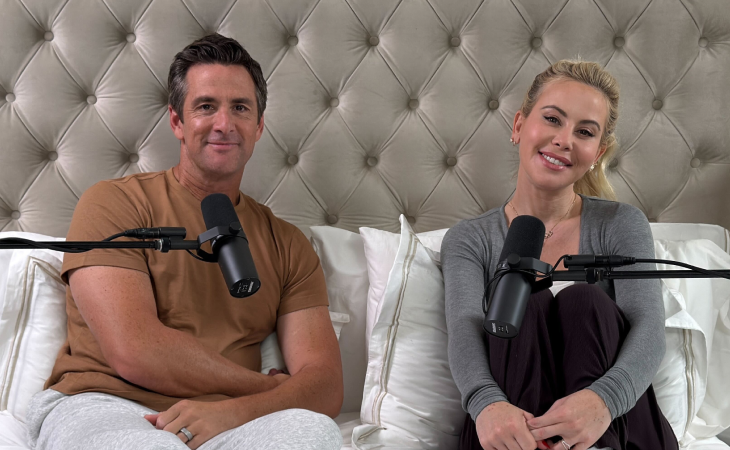
 How Sleep Affects Dopamine
Before we begin: This episode includes personal discussions about infertility, pregnancy loss, and the LA fires. Tara Lipinski is a Saatva partner. The experiences she shares are her own personal stories—not medical or professional advice. If you or someone you know is struggling with infertility or pregnancy loss, resources are available through RESOLVE at resolve.org. Please listen with care.
Welcome to Superpower, the podcast about how sleep, recovery, and mental resilience drive peak performance. In this episode, Tara Lipinski joins the podcast to talk about pressure, sleep, motherhood, and rebuilding after loss.
You can listen to this episode on Spotify or Apple Podcasts or watch the episode below.
Superpower podcast with Tara Lipinski: transcript
Introduction
Dave Briggs: Imagine knowing only perfection during one insanely pressure-packed four-minute performance could determine the rest of your life. Now imagine you’re just 15 years old. Welcome to the Superpower Bedcast. I’m Dave Briggs, and that was the situation facing young Tara Lipinski. She hops into bed to reflect on that moment and the challenges she’s overcome since, including a heartbreaking infertility struggle and later losing her home in the Palisades fire. She also tells us the one singer Tara would most like to crash into. But we start with Tara Lipinski’s most viral moment and no, it’s not what you nor even she would think.
Tara’s most viral online moment
DB: Everyone is familiar with your iconic skate in 1988. Is it true or false your most viral moment ever online?
Tara Lipinski: Oh, what is it?
DB: True or false, is it your most viral moment?
TL: Oh, is it? I think it has to be, right?
DB: It is not.
TL: It is not?
DB: I will tell you it is later in the show.
TL: Oh my goodness, this is fun.
DB: And hopefully we can get you to reenact that.
TL: Oh boy! Oh no, what could it be?
DB: I’m hoping. Oh, now your gonna jog and it’s a good tease for the audience.
TL: Oh, no!
Getting a good night’s sleep on the road
DB: Okay, so I had a terrible night of sleep last night because when I travel I don’t sleep.
TL: Were you not on a Saatva mattress?
DB: I was not, sadly.
TL: That can do it.
DB: It was not close. But I know you’re kind of a pro. You did this traveling as a skater, you do it as a broadcaster. Give me and our audience some tips. How do we sleep on the road?
TL: It’s hard sometimes. But I am old now, so I bring thing.
DB: Old? That doesn’t reflect well on me. Thank you.
TL: I bring things. I have my silk eye mask that I bring, I bring a little candle, I have my app sometimes that I sleep to to go to sleep.
DB: Like a sound machine going?
TL: Yeah.
DB: You literally sleep in the mask?
TL: Oh, I have to.
DB: We have those.
TL: I know. I use them.
DB: Maybe I should try that.
TL: You don’t do an eye mask?
DB: It freaks me out a little bit to not be able to see what’s going on around me. I’m a bit of a control freak.
TL: Yeah, I mean I like control too, but I’m telling you, it’s a good feeling. It feels a little weighted, there’s something soothing about it.
Being a morning person
DB: Okay. Let’s go through your sleep story. Do you go to bed late, do you go to bed early? What’s the last thing you’re doing in bed—are you doomscrolling?
TL: I am a morning person.
DB: You’re one of those bubbly people?
TL: Yeah, I wake up happy. I’m like, alright let’s go. 6 am, 5 am, whatever we need, let’s go. So I wake up early, which means I go to sleep very early, and now, having a toddler, I am so physically exhausted that I put her to bed sometimes at 7 or 7:30 and I will just wander to my room, take my makeup off, and will lay in bed and watch a show, and I’m in bed by 8:30.
DB: Wow, you are quite the party animal as a mom.
TL: I know, I’m a lot of fun.
Why sleep is important
DB: 8:30. And so how important is sleep to you now?
TL: Sleep has always been important to me, I think obviously for the health reasons, but it’s something that I grew up as a young skater, a young athlete, where it was drilled into me that sleep is important. There were no late nights just to have a late night, it was, you need nine hours of sleep. I got nine hours of sleep.
DB: Nine, solid?
TL: Solid as an athlete my entire career. So it was very important for me to have a schedule and a routine and go to bed at a certain time and wake up and feel rested and recovered to skate every day. I feel like that’s never left me, so I’m always looking for the nine hours—but I just don’t get there.
DB: I was gonna be astounded if you were getting nine.
TL: No.
DB: So let’s get back to your sleep journey. What happens when Tara doesn’t get a good night’s sleep?
TL: I can rough it. I feel like I’m so used to it now. I think being a mom, that changed everything, where you just don’t sleep sometimes and you just have to keep going. But I’m not great if it’s under five, I really, I struggle.
DB: The horns come out? What, can you not perform?
TL: No, I just feel, I think it goes back to, no matter what, I remember how it felt as an athlete to feel your physical best, and when I’m not feeling that, I’m very sensitive to it. I can feel it in my body, in my mind, and I’m like, ugh, get me to a bed.
Prioritizing sleep as a teen athlete
DB: I cannot function without sleep. But last night was a bad one, so I’ll try to get through this. So when you’re 15, though, you’re up at what, 4, 5 am? I’m assuming figure skating is one of the most difficult because of the hours of the training.
TL: So yes, I think with skating, skaters are used to being up early. But my years before going to the Olympics, I was at an amazing training center where they really catered to the skating program, so I had a normal hour of probably starting at 7 am. Before that, we as a family had moved to Houston from the East coast for my dad who had a new job, and we were skating in a town that was not skater-friendly. They just had no rinks, no training programs, so I skated at the Galleria, which is this giant mall in the middle of Houston. And during Christmas, they’d have a big Christmas tree in the middle of it, so my program would have a hole. But the worst part was that the only time they had ice for me was at 3:30 am. So I would wake up 3 and then go skate from 3:30 to 7:30 and then go to school. So those were very early hours. I did that for two years and then we were just like, we can’t function like this.
DB: How did you manage sleep at that point in your life?
TL: Going to bed very early.
DB: Because you knew it was that important to get sleep. I feel like we’ve all discovered this in recent years, but you knew it very early on.
TL: Yeah, definitely. Like I said, I’m very in tune with my body, from I think being an athlete and just knowing what it feels like to be well-rested and how ready you are physically, mentally, emotionally. And I find if I don’t get sleep, I’m depleted in all those areas—and then when I try to accomplish whatever goal it is, I’m just not at my best. I’m not firing correctly.
Difficulties napping
DB: Are you a napper?
TL: No, I cannot nap.
DB: Oh, you’re one of those. That makes it so much harder.
TL: It’s actually a very sore subject for me. I want to be a napper, more than anything, and I can’t do it.
DB: Yeah. That’s your dream, to be a napper?
TL: That is my dream. It’s the thing I want most.
DB: Why can’t you nap? What’s the problem? Have you tried? You can do anything—you won a gold medal at 15.
TL: No, I cannot nap.
DB: You can nap.
TL: I cannot nap. And I think now I have a mental block. I’d have to go to therapy for it. I think it’s that bad. I try it sometimes and then I get so upset, and so angry. And then if my husband naps and I can’t do it, then I’m even angrier.
DB: So what goes on? You lay down and the hamster wheel just won’t stop?
TL: I don’t know, I just can’t fall asleep if it’s a nap. It’s awful.
DB: Oh, that is difficult. Dare to dream, you can do this.
TL: I want to, but I can’t. Everyone in my life knows this. I can’t nap.
Unique sleep habits
DB: Do you snore? Do you talk in your sleep? Do you have any quirky things?
TL: No, but I move a lot. I’m moving constantly. I think there’s a lot of tossing and turning.
DB: And so your husband stays on the other side?
TL: He stays away.
DB: There’s no snuggling?
TL: I mean, I like to snuggle, but I think that through the night, I find myself, I wake myself up, I’m turning to each side.
DB: Very active dreamer.
TL: Yeah, just go to sleep, Tara.
Dealing with the pressure as a teen athlete
DB: Okay, so let’s go back. You’re 15, and I’m thinking about you when I’m watching the Ryder Cup the other day because here are the best golfers on the planet—that can hit a shot into the wrong fairway, that can hit a bystander, they can come back par the hole and win the tournament. You make the slightest mistake, that’s it, you’re done. Everything you’ve trained for is gone. How do you handle that kind of pressure at any age let alone 14, 15?
TL: I don’t think there’s some secret answer to it, and I think it’s just so difficult because, looking back, I was so young. I didn’t have a lot of life experience—so in a way, I think that, yes, I was so young, maybe I didn’t feel the pressure as intensely as if I was older. But then on the flip side of that, I think I actually did because I didn’t have life experience to balance me out. For me, it was all or nothing, black or white. I either won or I lost. It was do or die, where I didn’t think, oh, if I lose this, it’s okay, I have more in life to be grateful for. You know, you’re a kid and it’s just so extreme. So I think for me, the pressure, I definitely struggled with it, trying to be a 15-year-old in this very adult sport and have all these expectations on me. But I think that that’s what’s so cool about figure skating and some Olympic sports like gymnastics, it’s very similar. It’s not like other sports where you have so many games to make up something, and you have a two-hour game. You have four minutes, and that determines your whole path.
DB: Your life, in some regards.
TL: Yeah. And one little mistake—you can’t make any mistakes. So it is so high-pressure, and I think that’s why it’s so fun. For me, I love gymnastics, but it’s because I feel like it’s the same. They can’t make a mistake, it’s all on the line.
DB: And in this case, four minutes did define the rest of your life.
TL: It did. One mistake could’ve changed my entire life so completely.
DB: What if? Have you thought about it?
TL: Yeah. It would never have been this.
DB: You might have been doing something else entirely.
TL: Correct. I know it would be so different. It would be so different.
DB: What would you want to do, other than nap?
TL: Other than nap?
DB: What’s the one thing if you had fallen and taken a different turn in life? What would Tara Lipinski be doing?
TL: I don’t know. It’s so hard to try to think that through because being 15, I still was so young that I didn’t kind of think of what was next.
DB: Well, we’re happy you didn’t fall. So you’re also dealing with the pressure of your family in two different parts of the country, and your training was the reason. How much did that add to your level of anxiety as a kid?
TL: It definitely—you’re aware of all these things. Johnny Weir, my partner-in-crime, we talk about it all the time. Being so young and having a great support system in our sport, whether it’s the Federation or your family, your coaches—but at the same time, you also feel responsible for them. So it’s like, for me, thinking back to being a young girl, my parents, skating is a very expensive sport. And they did everything they could to keep it going. They definitely didn’t want me to be out of school, but they made that choice at a certain point because it was impossible to actually train and go to full-time school. So I just always had the thought in mind, I want to succeed not only for myself but for them.
DB: Did you feel pressure—you turned pro in a sense to bring your family back together. That’s a hell of a burden for a teenager.
TL: Yeah, I think it was a group decision. It was easier than most people think because at the time, I sort of won everything that I wanted to win in the fashion that I wanted to, you know. It’s not like I had a bad skate and was like, oh, I need to get that one back and stay in it. For me, I won Nationals, Worlds, Olympics, and had all of these incredible moments that there wasn’t really anything left for me emotionally that I needed—but, at the same time, I think life was hard. It was hard, the way we were living, and it felt like almost a gift that I won the Olympics and that maybe we can have a different life now and not go back to that same routine.
DB: And now you see these parents everywhere that are trying to raise the next Tara or D1 athlete or Olympic athlete. Are we pushing too hard as a society? Where do you draw the line as someone who did go through it, who did achieve all that?
TL: Well, I think for me, I love sports in general and just knowing that, looking back on my life, I think being in a sport, even if I didn’t win the Olympics, was really beneficial. I love the way that I sort of view life and work and career of just putting in the hard work—and I like the discipline, I like the routine. I think there are so many lessons you learn in sports that you can then apply to whatever you choose. So I feel like whether I won or not, I was so glad I was put into a sport and learned all of those life lessons really early on.
DB: But now that you are a parent, where does one draw the line between pushing and pushing and pushing and needing the kid to be the one? That’s a difficult balance for most parents.
TL: Right, and I think it’s probably case by case basis, and it’s really about your kid’s personality. Obviously, I was already a Type A, obsessive, I loved the routine.
DB: You wanted to be out there at 3 am.
TL: Yeah, I wanted to do it. And I think for me, I always say that my parents gave me all the opportunities. And they put me in every sport when I was little, and I was pretty opinionated, and I would be like, I’m done, I don’t like it. But skating was something that I actually had a passion for. So I think that if you’re in a sport where there’s a lot of pressure and expectation, as long as you—that’s my advice, as long as you love it, that should balance it out a little bit.
DB: Don’t push if they’re pushing back.
TL: Yeah, if they’re not actually actively loving what they do, then that’s not a good fit.
DB: You seem to have adjusted so well. I always wonder what it would be like to be the best in the world at anything at 15 and wonder, oh my god, what do I do now? How do I ever top that? Like Macauly Culkin in Home Alone at 10 or this kid from Adolescence who just won an Emmy at 15. What is your advice in handling that, the next chapter and trying to either top that or reconciling the rest of the way?
TL: Yeah, I think it’s interesting. For me, I felt very lucky that it happened so early. I won an Olympic gold medal at 15, where it almost put me on track with other kids that were going to school or going off to college and figuring out what they wanted to do next. Where I think sometimes in Olympic sport, it depends. If it’s a really niche Olympic sport that doesn’t have a huge following and you’re 28 years old or 30 years old and then retiring, that’s gotta really mess with your mind, of like, what is next for me. Whereas I was able to have this natural turnover at that age, and I also was living at the height of figure skating’s popularity—so again, I was very lucky to have a smooth transition to the next phase. It was like a soft landing because I toured for many years with Scott Hamilton and Kristi Yamuguchi, all these dreams that I had as a little girl, I was living out, and working, making money and transitioning to different life stages easier.
DB: Part of what made figure skating so big in that moment was of course Tanya Harding and Nancy Kerrigan. Do you have a memory of that and what that was like seeing happen as a young figure skater?
TL: I was so young, so it happened—
DB: I would say you were 13, 14?
TL: No, I was 12. So it was the Olympic cycle before me when all of that happened, and I think because I was so young, I was never really ever in the same arenas or atmosphere as the senior level skaters. But obviously, it rippled not only through our sport but pop culture and it made the sport insanely popular. We were rivaling football numbers at certain points. That Olympics was the highest rated moment in Olympic history. It’s crazy to think about what happened. Obviously such an unfortunate event but it definitely changed our sport.
Navigating a difficult fertility journey
DB: You say sports, and I agree, that it helps you for later in life—and it probably helped you survive, get through the biggest challenge of your life, which was your fertility struggle. And I know as an athlete, you actually defined that through some stats, through some numbers that talk about your struggles. What are those?
TL: Yeah, over the five years, I had an unexplained infertility diagnosis—for my husband and I, we just really never could figure it out, and so we just kept going. And it was 24 surgeries in those five years, eight retrievals, six failed transfers, four miscarriages. It was countless failure. They only thing they could tell us was maybe there was something with my immune system that was reject my husband’s DNA, so we chose surrogacy at a point where I was just rock bottom and there was really no way to try again. Emotionally, physically, we were just so tired.
DB: Spent.
TL: Yeah.
DB: Those were the numbers. What were some of the emotions going through all that?
TL: It’s really specific emotions that I think it’s hard to relay—because unless you walk that path, unless you go through it, it really is hard to explain. Because probably stepping into that, I would’ve thought, oh, that’s sad, that’s awful, I’ll get through it, this is how I’ll feel. And I felt, it was so much more extreme than I ever thought. And obviously I had experienced a lot of pressure and disappointment and failure in my life through sport, but this was next-level. Just the pain of wanting something so badly—building a family—and not being able to figure it out, not being able to work hard enough, not being able to do all of the things that you were taught to do, especially as an athlete.
DB: Yeah, you know, you performed, you get rewarded. In this case that just wasn’t the case.
TL: No.
DB: And you decided to share this battle with the public. Why, and how did that help?
TL: Well, I didn’t for five years, and it was very lonely and isolating and really hard to work through these times. I’m a broadcaster, so I’m on-air, running back and hiding and doing shots. It was painful to go through miscarriages while I’m working on live television and not be able to tell anyone. So I eventually, though, just felt, it’s time—it was almost like I had nothing to lose anymore. Like, what am I going to do? I’m probably not going to succeed, I thought at the time, which we did, which was great. But I just thought, why not open up about it and talk about a subject that I think still is a little bit taboo and not spoken enough about amongst family and women and people.
DB: It isn’t. And one in nine women have fertility problems in the United States—and one in six outside the United States. So what would be your message to someone that is going through it and is feeling the way you were?
TL: Just that all of those emotions are so normal and you’re not crazy and that there are a lot of people experiencing it. And I just think, looking back on my journey, it’s so hard to say what was the hardest part—was it the physical, was it the financial, was it the emotional, your relationship with your partner, or really the fear of it never working I think is the hardest part. And how do you tell someone how to fix that feeling? So you just have to feel it and hope that you have a really good support system. And I hope the conversation amongst infertility or miscarriage or loss just becomes more common because then I think people will obviously feel less alone.
Dealing with the LA fires
DB: So you get through it, you get this blessing, Georgie—and then adversity hits again and the LA fires and your home is virtually lost. That is everyone’s greatest fear, losing their home in a fire. Did it put things in perspective for you? Take me back to the moment that you saw your neighborhood going up in flames.
TL: Burning. You know, like I said, the fertility journey was really the worst thing I ever experienced. So this was, it’s awful, but it was a different kind of loss and grief and pain. And so I think I had been through so much over the past five years, I again, really used those tools to, it’s just a different type of grief. But you know, we never thought that was gonna happen that day. We left with barely anything, which I wish, now looking back, I took things because I didn’t, and it was silly.
DB: Is there one thing that you just wish you could—?
TL: I mean, just so much. It’s interesting, I took my Olympic skates randomly. As a skater, sometimes people have more than one pair of skates that they take, but I never did and a lot of skaters don’t, so you always were very protective, you knew where your skates were at all times. So I feel like it was old habit that I ran and just got my skates. And I took our dog’s ashes and I took some handbags.
DB: You did? Okay, I’m glad you admitted it. I think my wife, other than the photo albums, would get her bags.
TL: Yeah, I took some handbags, but it was just random, I was just going through the motions. But sitting there in our neighborhood, obviously, we started talking with one another, and people are looking on their Ring cameras and I’m getting photos of all the trees on the side of my house on fire, and you’re just like, oh my gosh, my house is gonna burn down, and everything in it is just sitting there. It’s a wild feeling, and it’s less about the material—I mean, obviously there’s so much mementos and things like that—but you start to realize it’s more just about your life feeling so destabilized all of a sudden. Because I would feel sad, like, oh, I drove past that Starbucks that burnt down and that gas station is where I would make my right and I’d see the kids walking down the street to school. All of that is gone, and that is almost the hardest part to understand—that that’s not there. That part of your life is not there anymore.
DB: And you don’t know if you’ll ever be back?
TL: Yeah, I don’t know if we’ll ever go back. There’s just so much, we were in sort of the epicenter of it. So we have damage obviously to our house and we just don’t know how severe it is to stay.
DB: Boy, I hope the Palisades is rebuilt. It might be the most beautiful part of this country.
TL: I know.
DB: Alright, enough of the adversity, right? You’ve had enough.
TL: Well, yeah.
DB: Can life just give you a break? Like, you’ve gone through—do you feel that way?
TL: I say that, but yes and no. Yeah, there’s been things, but especially with the fire, it made me realize, I’m so lucky because we’re able to, we have the resources to find a rental and move on. There are so many people in the Palisades, in Altadena, and just think about all the fires that are happening that may not be publicized in the same way that are not in that same position, and I think about them daily. Because the news cycle goes on and you forget about—
DB: Oh, we move on, yeah.
TL: But there are so many people, and truthfully, all natural disasters. It’s opened up my perspective to what people are going through and especially people that don’t have insurance, don’t have the means to start over and how devastating that is. So for me, it’s given me perspective, and I don’t look at it as something so awful that I went through because I feel so lucky that we have the ability to move on.
Thoughts on Team USA
DB: That’s some pretty awesome perspective. Alright, so 2026 Milano Cortina. I know you’re very jacked about this Team USA. Why?
TL: Well, I think skating is gonna just sort of have this renaissance this year because there’s been maybe a drought for two decades. I don’t even know how long, I’d have to go back and look at the exact years, but we haven’t really had that many American skaters primed to win an Olympic gold medal. And you have four disciplines in figure skating—dance, pairs, men’s and women’s—and I think there’s a possibility that out of the three, there could be American gold medals, which is just very exciting.
And you have talent like Ilia Malinin, who is something out of a superhero comic book. Who are you? I don’t even know how you’re doing this. I never thought I’d see this in my lifetime on the ice, and I think there’s a chance he may leave the sport at some point and we’ll never see it again. It’s that special.
DB: Is this the Quad God?
TL: This is the Quad God.
DB: I know you made famous the triple loop-triple loop. Put in perspective this quad and how unusual it is in the sport.
TL: Well, it’s four revolutions, but what he does, though, he does a quad axel, which is four and a half revolutions. And you look back to, there was a Japanese skater, Yuzuru Hanyu, who won back-to-back Olympic medals and is regarded as one of the best skaters of all time, he was just genius, and he wanted to land the quad axel and for years was trying and trying and trying. We watched him and he never came close. I mean, he came close, but never in the way that Ilia is, it’s like he could do it in his sleep, and this talent is so raw and his natural ability to turn and jump in the air is so impressive, so he does all of the quads. He stacks them in his program and puts them in combinations and it’s just, it’s outrageous.
DB: It’s Lebron, it’s Tom Brady. Aaron Judge. Things we’ve never seen before.
TL: Yeah, when people tune in, it’s sort of, when you watch Simone Biles, I’m lucky I get to watch her. She’s one of the greatest and will be for all time. That’s the same with Ilia. It’s like a spectacle.
DB: You’re back with Johnny Weir. I think your best friend, right? What’s the weirdest situation you’ve ever found yourself in?
TL: Oh, we have been in every situation. We went to the Sochi Olympics in 2014 as the B team and then we had really great ratings and we came home and sort of got a promotion, and from that moment, we’ve had the strangest life together, work life together, because we just show up anywhere. They’re like, come to the Super Bowl. Okay. Kentucky Derby, the National Dog Show, we hosted a wedding cake show, last week we were in Scotland, we did Traitors, then we went back and did a travel show. We just sort of do, jack of all trades, and it makes zero sense but it makes all the sense in the world. So we just take any opportunity.
DB: Kentucky Derby, dog show, wedding cake show. You’re a package deal. I believe he even played a role in your infertility journey if I recall.
TL: He did. He would give me shots. Obviously, I told him everything. But he was such an anchor for me and always has been. We’ve been through so much together through the years. It’s over a decade now. So think of all the things that go on in your life simultaneously while you’re working. We as best friends kind of do both together. We go on air and we put on our show and then come home and we sit on the bed like this afterwards and talk about our life problems.
DB: Okay, so LA 2028, right here, just a few miles away. If there was a sport you could compete in—?
TL: Gymnastics.
DB: Gymnastics would be it? Because that’s a sister sport?
TL: Yeah, it’s sort of the sister sport. But for me, it’s always seemed so fun. The beam and the vault and all these different things—as a skater, we just get the ice. They have all those apparatuses.
DB: And so would your favorite Olympic athlete other than yourself be whom?
TL: I mean, there are so many that I look back on, whether in my sport of skating but also someone like Simone Biles, watching her. And also her journey and the mental health journey and really I think just breaking again, another taboo subject that needed to be talked about. Even the best in the world, you know, they’re going through things. It’s normal. It’s hard.
DB: Would you like to be in the booth in ‘28 for gymnastics, if you had one sport?
TL: Wouldn’t that be fun? Johnny and I always say it would be really fun to do rhythmic gymnastics.
DB: Okay, NBC.
TL: You know what I mean? I feel like that would be a perfect one for us.
DB: We’ve planted the seed.
Rapid fire questions
DB: Okay, couple of rapid fire questions. We’re going to take you back to your most viral moment ever.
TL: Will you tell me what it is?
DB: It is not your gold medal skate.
TL: What could it be?
DB: What could it be?
TL: I literally have no idea.
DB: Let me ask you this: What would be your karaoke song or your lip sync song? If you had to sing karaoke—?
TL: But see, I’m a terrible singer, so it can’t be me singing. There’s no where—where would it be?
DB: It is your lip sync battle.
TL: Oh, lip sync. Okay, so I’m not singing.
DB: “Hollaback Girl,” I believe.
TL: Is that really—?
DB: It is very close but is a few hundred thousand more than your gold medal skate.
TL: That’s not true.
DB: It is true.
TL: What? Yeah, Johnny and I did that show together. That’s so funny.
DB: That’s surprising to you, isn’t it? It was quite a performance. You did not sing, but you rocked it.
TL: I also, there were two performances there. I did a rap, I think.
DB: “Hollaback Girl” is your most viral video of all time. So good luck topping that.
TL: Oh yeah, I mean, I don’t know how I’m going to do that.
DB: What would be your karaoke song if you had to sing?
TL: If I had to sing. I don’t—
DB: Everybody has to be forced on a karaoke stage at one point.
TL: No, you have no—my voice is, I’m tone deaf I think, and it’s so bad. I can’t sing.
DB: Oh, so not even in the shower, not in the car?
TL: No. I mean, I’ll sing. I’ll sing in the car, but I look over and it’s like, my friends—
DB: So your karaoke song is no song.
TL: No song. My friends are like, you gotta be quiet.
DB: Wow, it’s that bad.
TL: It’s that bad. They’re like, stop.
DB: One celebrity you could skate with. In a way of saying your celebrity crush would be…
TL: My celebrity crush.
DB: You could do a duet with.
TL: Dave Matthews. I love Dave Matthews. He is probably, he’s the only person that I need to meet. I met him. I’m a big Dave Matthews fan.
DB: So a duet—
TL: Yeah, I feel like that would be perfect because I always said I wanted to skate to Dave Matthews. I never did back in the day.
DB: What song would it be? “Crash Into Me” I think would be pretty great.
TL: Yeah, I like “You and Me.” “You and Me” would be a great one to skate to. “#41.” There’s so many.
DB: Okay, we’ve got, you need to nap, you need to skate with Dave Matthews, and you need to be in the booth for gymnastics for LA 2028.
TL: Bucket list items right there.
DB: We’ve got your to-do list.
TL: Great.
In closing
DB: Thank you for being in bed with us.
TL: Thank you.
DB: We really appreciate it.
TL: This was so fun.

Saatva Editorial Team
The Saatva Editorial Team is comprised of writers and editors who specialize in creating content about mattresses, bedding, and sleep.
Related Stories


Table of Contents
