
 What Can a Maintenance of Wakefulness Test Reveal About Your Daytime Alertness?
Sleep Disorders & Conditions, Sleep Health
November 17, 2026
BiPAP vs. CPAP: What’s the Difference?
Written by Hailey Hudson
Key Takeaways:
- CPAP delivers one continuous air pressure to keep airways open, whereas BiPAP alternates between a higher pressure on inhalation (IPAP) and a lower, easier-to-exhale-against pressure on exhalation (EPAP).
- Most obstructive sleep apnea patients start on CPAP—which is more affordable and widely covered by insurance—while BiPAP is typically reserved for underlying lung or neuromuscular conditions like COPD or ALS, or for patients who cannot tolerate high CPAP pressure.
- Ease into PAP therapy comfortably by getting a professional mask fitting, wearing the mask while awake to acclimate, and using side-sleeper CPAP pillows or hose holders to prevent leaks.
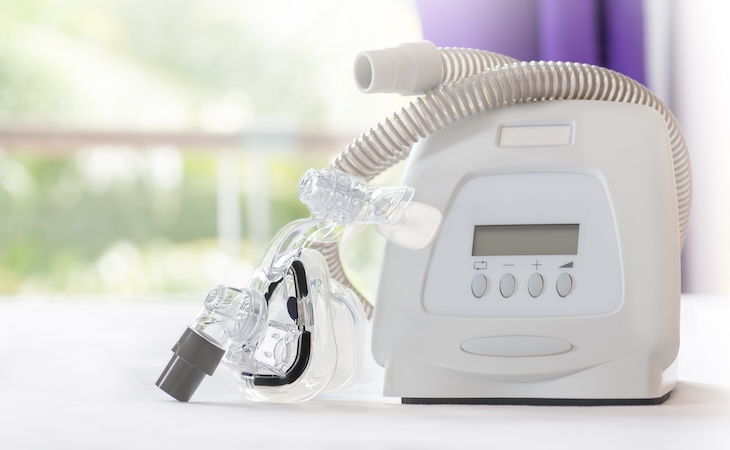
CPAP and BiPAP machines look nearly identical. But while both machines use pressurized air to keep your airway open while you sleep, they work in different ways—and they’re prescribed for different reasons.
Understanding the difference can help you know what to expect from sleep apnea treatment and what to ask your doctor if your current setup isn’t working.
Overview: CPAP vs. BiPAP Positive Airway Pressure Therapy
CPAP and BiPAP machines deliver two types of PAP therapy, a medical treatment for sleep apnea.
Continuous positive airway pressure (CPAP) is when the device provides one steady pressure. BiPAP is two pressures—a slightly higher pressure when you breathe in, and a slightly lower pressure when you breathe out.
“Oftentimes patients find bi-level a little more comfortable, because when you exhale, you’re breathing against less pressure,” explains Meagan Rizzo, MD, medical director and sleep physician at The Center for Sleep & Wake Disorders. “So that’s kind of the general difference between the two.”
The large majority of patients who need treatment for obstructive sleep apnea, however, will end up on CPAP.
If BiPAP can be more comfortable, why doesn’t everyone use it? Because for most people with obstructive sleep apnea, CPAP does the job.
“The vast majority of patients can have their sleep apnea well treated with the pressures available on CPAP,” Rizzo says.
BiPAP is typically reserved for people with certain lung conditions or those who struggle to tolerate high CPAP pressures, and insurers are often reluctant to cover the more expensive device.
How PAP Therapy works
Before getting into the weeds of BiPAP vs. CPAP, it’s helpful to understand PAP therapy in general.
In people with obstructive sleep apnea (OSA), the airway intermittently collapses as they sleep, interrupting their breathing. Positive airway pressure (PAP) is a therapy for OSA that works like an air splint for your throat. A steady stream of pressurized air holds the airway open from the inside so the soft tissues can’t collapse and block your breathing while you sleep.
CPAP and BiPAP are two specific types of PAP therapy.
How CPAP works (Continuous Single Pressure)
CPAP works by delivering one continuous, preset air pressure as you inhale and exhale. As Rizzo explains, most people with sleep apnea start on CPAP and stay on CPAP.
Many people now start with auto-CPAP, which Rizzo describes as “a form of straight CPAP, but [with] a range of pressures we set into the device.”
Instead of delivering a single pressure all night, auto-adjusting PAP (APAP) varies the pressure as it detects obstructive respiratory events. This may be more beneficial because your sleep apnea symptoms can change over time. They fluctuate depending on factors like:
- Weight changes
- Nighttime alcohol consumption
- Body position
- Sleep stages
- Changes in upper airway anatomy
APAP is as effective as CPAP in helping lower breathing pauses during sleep and improve quality of life. You can also start APAP without an overnight in-lab titration study (where sleep techs experiment with different CPAP pressures to find the one that seems to help most with your sleep apnea).
How BiPAP works (dual pressure: IPAP and EPAP)
Like CPAP, BiPAP also blows pressurized air through a mask to prevent your airway from collapsing. But instead of holding one steady pressure, BiPAP switches between two.
- Inspiratory positive airway pressure (IPAP): This is the higher pressure, delivered when you breathe in. It supports each breath by pushing more air into your lungs.
- Expiratory positive airway pressure (EPAP): The lower pressure happens when you breathe out. It’s still strong enough to keep your airway from collapsing, but it’s not too difficult to breathe against.
Most BiPAP machines sense when you start to inhale or exhale. They automatically switch between the two pressures to match your breathing. Some models can also adjust pressure levels throughout the night, or deliver a breath on a set schedule if you don’t take one on your own.
This might sound similar to an auto-CPAP, and it is. But the key difference is that CPAP always uses a single pressure for inhaling and exhaling, while BiPAP uses two.
Key differences: airway resistance, breathing comfort, and cost
There are noticeable differences in how a CPAP and a BiPAP feel. While the experience varies from person to person, it typically feels easier to breathe against BiPAP because you’re getting the drop as you’re exhaling.
“The difference is probably more pronounced as you go up higher on the pressure settings…[but] it’s not always based on a number,” Rizzo says.
BiPAPs and CPAPs also vary in cost. If purchased outright, CPAPs are usually around $950, while BiPAPs tend to be closer to $2,000. However, insurance companies usually have patients follow a rent-to-own structure with a payment plan over a period of several months.
Most insurance companies require you to try CPAP first. You’ll need documentation of failure—a note in your medical chart explaining why it didn’t work for you — before you can qualify to use BiPAP.
The area where PAP devices don’t differ is in looks. BiPAPs and CPAPs are the same size and usually about the same volume. In fact, you frequently can’t even tell which type of machine you’re looking at.
“They’re honestly the same models with a little bit different software inside them,” explains Matthew Henning, practice manager at The Center for Sleep & Wake Disorders. “Most BiPAP machines can be programmed to operate as CPAP or APAP devices, so it’s really more about the functionality. The shell is the same.”
Who needs CPAP vs. who needs BiPAP (medical indications)
There’s only a small subset of patients where BiPAP would be the starting choice, and those are patients with underlying pulmonary conditions—primarily hypercapnic respiratory failure.
“It’s really kind of this niche thing that we work with pulmonologists to get patients to qualify for,” Rizzo says. “But that would be kind of an overlap syndrome where patients would have obstructive sleep apnea and another underlying pulmonary condition.”
Beyond overlap syndrome, doctors may prescribe BiPAP for several other conditions where breathing itself takes extra effort. People with COPD, for example, often have trouble fully exhaling, which traps air in the lungs and allows carbon dioxide to build up. BiPAP’s lower exhale pressure makes it easier to breathe out, while the higher inhale pressure helps move air in.
For people with neuromuscular diseases such as ALS, weakened breathing muscles can’t always pull in enough air on their own. BiPAP’s inhale pressure helps do some of that work.
BiPAP may also be used for central sleep apnea, where the brain doesn’t consistently signal the body to breathe. In these cases, some BiPAP machines can be set to deliver a breath automatically if you don’t take one on your own.
The vast majority of obstructive sleep apnea patients start on CPAP. But if the pressure feels too strong, some people find themselves working too hard to breathe out.
High pressure can also cause mask leaks, dry mouth, irritated eyes, and aerophagia—swallowing air, which can leave you bloated or gassy in the morning. In these cases, patients might transition from CPAP to BiPAP for comfort reasons.
How to transition to positive airway therapy comfortably
For many people, starting PAP therapy can be difficult. There might be many reasons why you struggle to use your CPAP or BiPAP consistently each night:
- You’re not used to the way the pressure feels.
- The mask makes you feel claustrophobic.
- You move around a lot in your sleep and it’s difficult to deal with the hose and mask.
- You’re dealing with a dry mouth, dry eyes, or aerophagia.
- You feel self-conscious about your bed partner seeing you with the mask on.
Wearing your mask while you sleep, however, is important—not only to reap the benefits of this medical treatment, but also for your insurance. If you’ve been prescribed PAP therapy, your insurer likely requires you to use your machine for a minimum number of hours per night, or they won’t continue covering it.
The first step is making sure your mask fits. A sleep technician can walk you through an in-person mask fitting, trying different types of masks—a nasal mask, a nasal pillow mask, a full face mask—to see what’s comfortable for you. It’s important to have a good medical team there to support you as you’re getting started.
Next, if you’re still having trouble getting acclimated to the machine, practice wearing your mask around the house while you’re awake. During that getting-to-know-you period, the more you wear it, the easier it’s going to be.
“I always stress it’s like getting reps,” Henning says. “And getting time on the mask helps remove some of the noticeability.”
You can also find sleep accessories that might help. For side sleepers, if you’re bothered by the mask hitting the pillow, look into contoured pillows specifically designed for CPAP users who sleep on their side. These pillows have a cutout for your mask, reducing leaks and keeping your neck aligned. Other available products include “hose holders” that hook up to the headboard, or soft liners that slide over the tubing.
“There’s a lot of variables in play,” says Henning. “Don’t be frustrated.” He acknowledges that some nights are going to be better than others.
“My line is always progress, not perfection,” says Henning. “If you go into it with that mindset, try to get 1% better every night, you’ll get there.”
FAQs
Is BiPAP stronger than CPAP?
BiPAP isn’t necessarily a more powerful version of CPAP. It simply delivers pressure differently. CPAP uses one steady pressure, while BiPAP switches between a higher pressure when you breathe in and a lower pressure when you breathe out. BiPAP is typically used as an alternative for people with specific, more complex health conditions.
Why would a doctor prescribe BiPAP instead of CPAP?
A sleep doctor might prescribe BiPAP in a small subset of patients who have underlying pulmonary conditions in addition to obstructive sleep apnea. Usually, however, CPAP is the first line therapy.
Can you switch from CPAP to BiPAP if exhaling feels difficult?
Yes. If you feel that the pressure from your CPAP is too strong and you’re working too hard to breathe out—leading to issues such as mask leakage — you can switch to BiPAP if your insurance approves the change.

Hailey Hudson
Hailey Hudson is a full-time freelance writer and content marketer based out of Atlanta. She writes about healthcare, marketing, and pets for clients like Healthline, Adobe, and Chewy. In her spare time, Hailey writes YA novels, snuggles with her cat, and sings musical theater (not all at the same time).
Related Stories
-
What Can a Maintenance of Wakefulness Test Reveal About Your Daytime Alertness?
-
 Why Do I Wake Up Before My Alarm?
-
 How to Sleep Better With Ankylosing Spondylitis
Table of Contents
