
 Why Do My Pillows Turn Yellow?
Key Takeaways:
- Powder detergent excels at lifting particulate outdoor soils like mud, clay, and ground-in dirt, often incorporating oxygen-based bleaching agents that brighten washable whites.
- Choosing between powder and liquid comes down to the task: powder provides economical cardboard packaging for heavy soils, while liquid dissolves faster for grease stains, cold cycles, and pretreating.
- White marks left on laundered fabrics are rarely proof of bad detergent; they usually stem from overdosing, overloaded wash drums, or cold water temperatures preventing full dissolution.
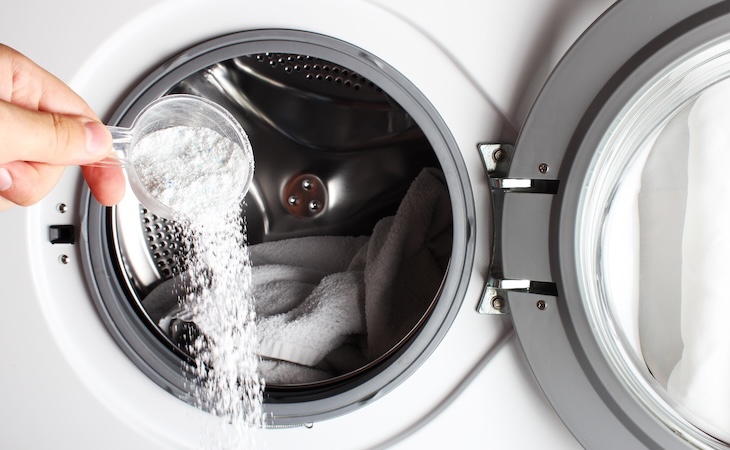
I grew up using powder detergent before switching to liquid, and here’s the good news—powder detergent does work very well to remove stains.
Of course, that’s contingent on the type of stain we’re talking about here, but when it comes to some tough stains, powder detergent may just become your new best friend.
“Powder detergents generally combine surfactants, water-softening builders, and other cleaning ingredients in a dry formula,” explains Sofia Martinez, the owner of Sparkly Maid Austin. “Powder is especially useful for particulate and outdoor soils such as mud, clay, and ground-in dirt.”
To get a more well-rounded view of powder detergents and how they work to remove stains from clothing and bedding, I tapped Martinez for her thoughts. Keep reading to find out more.
Do powder detergents really work?
The short answer? Yes. “Powder detergents can work extremely well,” says Martinez.
However, their performance depends on certain factors like formula, type of soil, water temperature, water hardness, dosage, and whether the powder dissolves completely.
Martinez explains that while powder detergents work especially well on mud, clay, or ground-in dirt, they do have their limits.
“They can perform poorly when too much is used, the washer is overloaded, or the product does not dissolve fully,” she says.
And if you notice white marks on your clothes or sheets after washing? That might not be the powder detergent’s fault but an indication that something is wrong with your washing machine instead.
“White marks after washing usually indicate a dosing, dissolving, rinsing, or loading problem rather than proof that powder detergent is ineffective,” she says.
Pros and cons of powder laundry detergent
While powder laundry detergent can be pretty miraculous, it also has some pitfalls. Let’s get into the pros and cons.
The pros: great on mud, lower cost, and eco-friendly packaging
Pro: effective on mud and ground-in soil
“I often prefer powder for gardening clothes, children’s outdoor clothing, sports uniforms, and other washable fabrics affected by mud or clay,” Martinez says.
She lets the mud dry, brushes as much of it away as possible, and then pretreats or washes with powder.
Pro: potentially lower cost per load
Because powder is concentrated and doesn’t have the water found in liquid detergent, it may be more economical to use it on laundry day.
Martinez advises comparing the cost per correctly dosed load instead of comparing package prices. “A large box is not economical if the user routinely adds twice the recommended amount,” she explains.
Pro: less plastic packaging.
“Many powders come in cardboard packaging and require less plastic than detergent sold in a large plastic bottle,” Martinez says. “Because the manufacturer is not shipping a water-heavy liquid, powder may also be lighter and more compact per usable load.” However, she’s resistant to make a broad environmental claim since factors like concentration, ingredients, shipping distance, and washer efficiency can affect the overall environmental impact.
Pro: useful for whites and heavily soiled loads
“Some powder detergents contain oxygen-based bleaching or water-conditioning ingredients that can help with washable whites and everyday dinginess,” says Martinez, who likes using them in this case.
The cons: can leave white residue in cold water
Con: might leave white or gritty residue
“Powder can leave pale spots or grains on clothing if it does not dissolve or rinse completely,” says Martinez.
She notes that this happens more frequently with extremely cold water, hard water, an overloaded washer, excessive detergent, short cycles, or incorrect placement in your washing machine.
Con: more inconvenient to pretreat
If you have a stain that needs pretreating, you may want to use liquid instead of powder.
“Liquid detergent can usually be applied to a compatible washable stain more easily,” says Martinez.
Con: messy to measure out
If you don’t have a scoop for your powder detergent, all bets are off.
“Accurate measuring is harder if the scoop is missing,” Martinez says. She adds that powder spilled around the washer “may absorb moisture and become sticky.”
Powder vs. liquid detergent: which is better?
Here’s the thing: When you’re trying to decide between using liquid detergent or powder detergent, it may just come down to personal preference or a host of other factors.
“Neither is universally better,” says Martinez. “I choose according to the stain, fabric, wash cycle, water conditions, and household routine.”
Martinez recommends using powder detergent for mud, clay, ground-in outdoor dirt, or washable whites. Additionally, she advises using powder detergent if you want a dry concentrated product in cardboard packaging.
Meanwhile, Martinez suggests reaching for liquid detergent for greasy or oily stains, cold or short cycles, handwashing, and pretreatment.
When it comes to bedding, “either form can work,” Martinez says. “Proper dosing and complete rinsing matter more than whether the detergent began as a powder or liquid—using extra detergent does not make sheets cleaner.”
How to use powder detergent without leaving spotty residue
I don’t know about you, but I hate when I take my laundry out of the washing machine and see white residue left on my clothes (which tends to happen pretty frequently when I use my apartment’s washing machine, unfortunately).
Martinez has some tips and recommendations on how to use powder detergent without finding pesky residue on your clothing and bedding afterward.
Before dropping your items into your washing machine, Martinez recommends measuring for the load size, soil level, and water hardness.
“I start with the recommended amount rather than automatically filling the scoop,” she says.
Be sure you’re not overloading the drum, either since “clothing and bedding need room to circulate through the wash and rinse water,” she says.
Plus, don’t use water that’s too hot. “Use the warmest water permitted by the garment label when poor dissolving is a recurring problem,” she says. “I never raise the temperature beyond what the fabric can tolerate.”
When it comes to drying your clothes, be certain they’re not marked first.
“If clothing comes out with white marks, I do not put it in the dryer immediately,” she says, since dryer heat can make them tougher to remove. “I rinse or rewash the item without adding more detergent, then correct the original dosing, loading, placement, or cycle problem before washing another load.”
Invest in new sheets from Saatva
This carousel automatically rotates through products. Use the pause button to stop rotation, or use the slide dots to navigate.

Organic Sateen Sheet Set
Shop Now
It’s easy to see why our flagship organic cotton sheet is a bestseller. Its silky-soft, 300 thread count sateen weave is made with 100% certified organic cotton. It’s better for the planet and feels indulgently luxurious on you.
Percale Sheet Set
Shop Now
Pamper yourself in deluxe comfort with our breathable percale sheets. They’re made from the world’s best long-staple cotton that gets softer and better with every wash.

Essential Sheet Set
Shop Now
This upgraded staple is woven from percale cotton and viscose to create an extremely soft, lightweight, and breathable sheet that gets softer with every wash.

Embroidered Sateen Sheet Set
Shop Now
Wrap yourself in the five-star luxury of our elegantly trimmed organic cotton sheets in a silky-soft, 300 thread count sateen weave that gets softer with every wash.

Signature Sateen Sheet Set
Shop Now
Wrap yourself in the five-star luxury of our signature cotton sheets in a silky-soft sateen weave that gets softer with every wash.

Banded Percale Sheet Set
Shop Now
Indulge in five-star hotel luxury right in your own bedroom with our banded percale sheets. They’re made from breathable long-staple cotton that gets softer and better with every wash.
FAQs
Is powder detergent better than liquid detergent?
It isn’t really about whether one is better than the other overall but which one may work for which situation. Powder detergent can be better for stains like mud, clay, or ground-in dirt, while liquid detergent is preferable for grease stains, cold or short cycles, handwashing, or pretreating items.
Why does my powder detergent leave white marks on clothes?
Finding white marks on your clothes after washing them with powder detergent can be due to a few factors. It might mean that there’s a problem with your washing machine and isn’t necessarily the powder detergent’s problem. However, powder detergent may be the culprit if it doesn’t dissolve or rinse completely, which might happen if you’re washing with extremely cold or hard water, overloading your washer, washing with too short a cycle, or using too much detergent.
Can you use powder detergent in cold water?
If your water is too cold, powder detergent won’t work properly since it can’t fully dissolve. Martinez recommends washing your clothes with the warmest water permitted on the garment label, but refrain from going any higher.
Time for new sheets? Here’s what Saatva offers
Are your sheets past their prime? If you notice stains that won’t wash out, yellowing, or discoloration, it’s time to replace your sheets.
We offer a wide range of bedding to suit every preference, including organic sateen sheets and percale sheets. Check out our full selection of sheets to find your perfect match.

Jamie Sanders
Jamie Sanders is an LA-based copywriter and blogger with 20+ years of experience in fashion, beauty, and lifestyle. After 12 years in New York City and a brief stint in Pittsburgh, she (finally) relocated to Los Angeles in 2015. Her work has appeared in InStyle, Harper’s Bazaar, Shape, Allure, TODAY.com, and Glamour, among others. She also started her own blog, The Beauty of Life, in January 2007. Over the years, she’s cultivated her obsessions of bold nail polish, candles, Bonne Bell Lip Smackers, Minnie ears, and strappy-heeled sandals. When Jamie isn’t working, you can most likely find her exploring the Los Angeles bar and restaurant scene, traveling, or enjoying time at Disneyland.
Related Stories
-
Why Do My Pillows Turn Yellow?
-
 What Is a Bolster Pillow?
-
 Fleece vs. Flannel: What’s the Difference?
Table of Contents
